






































 Listen
The author describes how a teenager with anger management issues found renewed hope through social and educational services, one-on-one counseling, and a new assessment checklist that identifies key areas for developing resilience in youth.
”You need to remember that blood is thicker than water and that your family will always be there for you,” I overheard a young college intern explain to Greg, a 6-foot, 230-pound 16-year-old who has been in the juvenile justice system for the past 4 years. Greg responded, “You don’t know much about me and my family.”
I was filled with pride when I heard Greg’s response. A year ago, the intern would probably have had to dodge a flying desk. Greg’s history of violent behavior is not surprising. Youth between the ages of 15 and 24 have the highest rate of violent criminal offenses of any segment of the population (Brennan, 1999). Regardless of age, gender, race, or demographics, all youth can benefit from learning techniques to deal with daily stresses. This kind of resilience skill building is a cornerstone in the foundation of the juvenile transition process that enabled Greg to build his resilience skills by improving his anger management, communication, and social skills.
Roles of Resilience
Resilience, or the ability to rebound from adversity, also includes an ongoing process of managing one’s life especially during stressful or traumatic situations. Youth who are troubled, come from broken homes, or have a wide array of other difficult life situations can gain the most from developing this skill. These youth need to engage in new experiences, ideas, and relationships (Walsh, 1998) to develop self-esteem and self-efficacy: two essential components of youth resilience (Novick, 1998).
Strengthened through trust
Research indicates that youth who handle adversity best typically turn to people whom they have learned to trust. A young person’s resilience during difficult times is strengthened if he or she has at least one adult to trust and confide in (Walsh, 1998). These are usually people whom they see regularly, such as teachers, counselors, ministers, extended family members, and friends. These youth often find sanctuary at school, especially when things get really tough in their lives (Bushweller, 1995). Although school may seem like an unlikely place for a juvenile offender to seek refuge, many youth view it as the one stable, guiding force in their lives.
Special needs and education
Behavior disorders, mental health issues, special education needs, and environmental factors playa role in the resilience of youth. The statistics for conduct disorders project that as many as 60% of youth within the juvenile justice system have various forms of conduct disorders (Briscoe, 1996). Special education statistics show that one of every two young people who are adjudicated delinquents require special education attention.
Forty-four percent of juvenile offenders will drop out of school by ninth grade and attain approximately fifth-grade reading levels (Cottle, 1998). Other characteristics of high-risk offenders that call for additional concern include a history of family violence, abuse within the home, availability of drugs, drug usage by a parent, other convicted or adjudicated family members, special education status, and first adjudication at age 13 or younger (Armstrong, 1991).
Resilience through modeling
Helping a youth in need of special help develop his or her sense of social responsibility is an important step toward resilience. Lessons in responsibility are best taught through modeling by professionals in the field (Errante, 1997).
Engaging young people with creativity and humor not only makes learning fun, but also alleviates negative behaviors, thus allowing more positive connections to occur (Goldstein & Conoley, 1997). Role playing, role reversal, and other hands-on approaches help youth understand how and when to use learned behaviors such as resilience skill building (Antonietti, 1997). Turning to positive role models to teach young people how to cope with the difficult issues within their various communities will allow youth to see options other than violent or deviant behaviors (Garbarino, 1999).
A Journey From Rage to Resilience
Even the most serious and habitual juvenile offenders can become more resilient. The angry young man who showed restraint after the “blood is thicker than water” comment had attended school at a center for students with severe emotional disturbances (SED) since the age of 6, when he was kicked out of first grade. Greg’s family includes his 36-year-old mother, his absent father, 14 siblings ranging in age from 2 to 21, and various extended family members who are sometimes in jail. Greg lives in the inner city of St. Petersburg, Florida, and has experienced the effects of drugs, violence, and poverty his entire life.
Fortunately, Greg’s grandmother provided a wonderful support system-she raised him and his 14 siblings until her death. Greg did not engage in any serious criminal activity when his grandmother was alive. However, after her death, he was charged four or five times each year with aggravated assault and battery. Eventually, he was placed in a residential commitment program, where he did surprisingly well and showed great signs of leadership.
Once Greg was released from his program, he went home to the same environment, family, and circumstances that had caused him problems in the past. However, there was one major difference this time: Greg was placed under the intensive community supervision of the Pinellas County Sheriff’s Office Serious and Habitual Offenders Tracking and Monitoring Program and Advanced Aftercare Services, a grant project with the University of West Florida and the Florida Department of Juvenile Justice. In my work with Advanced Aftercare Services, my goal was to help Greg return to school, find a job, and comply with other court-ordered sanctions.
Taking Greg to register for school was difficult because most of the teachers had at one time been physically or verbally accosted by him. At the beginning of the school year, I nearly lived at the school, trying to keep him from getting kicked out after he threw books, pencils, and papers at teachers and other students. The linking of services among the school social worker and behavior specialist, teachers, and administrators structured, mediated, and controlled Greg’s experience. Numerous meetings were held to revamp and make adjustments to Greg’s individualized education program and behavioral contracts. The entire time, Greg continued anger management classes with me, where we would often role-play school scenarios.
Several weeks before Christmas break my pager went off and I groaned. Reluctantly, I made the call to Greg’s school. After the behavior specialist told me what had transpired, I said, “This is real progress.” Although Greg had sworn at a staff member and said that he would like to hit her, the behavior was only verbal. Granted, it was still inappropriate behavior, but he had finally proven to himself that he had control over his body.
Greg’s behavior improved even further until his best friend was arrested and placed in a residential commitment program several hours away, and his mother asked that he be removed from the home because he refused to baby-sit the younger children. The downward spiral started again. I asked the Department of Children and Families to help with the younger children, and joined others in encouraging Greg to look for a job. He had already been through a series of employability and life-skills workshops where he participated in mock interviews, completed a resume, and filled out applications. With some help, Greg found a job at a popular fast-food restaurant. Although he never made much money, he was proud of making it himself.
Temporary custody was granted to the grandfather until Greg’s mother could get herself back on track. Thankfully, a friend named Bud entered the picture at this point. Stable and near Greg’s age, Bud was working on his GED and had never been in trouble with the law (something that is almost unheard of in the neighborhood). I encouraged Greg to spend time with Bud instead of his old friends, who were dealing drugs. Meanwhile, his mother was ordered by the court to attend parenting classes and family counseling, and Greg was allowed to spend at least 10 hours a week with his mom and siblings, so that the ties could be rebuilt.
When his behavior at school improved again, the faculty, staff, and Greg met to discuss the prospect of Greg returning to a regular school. The meeting ended when Greg said he did not care anymore and insulted the principal. To this day, Greg swears he wants to leave the SED center, but every time his behavior warrants a trial assignment he starts to have problems again. It seems that he needs the extra attention and structure of the SED center. Even though he claims to hate going to the “stupid school,” he seems happiest when he is there.
Several weeks ago, Greg told me education was the key to his success. When I asked why he thinks he made it, he said, “That’s easy, at first it was’ cause you believed in me. After a while, I got tired of you always thinkin’ I could do all this stuff, you know? So I guess if you think I can do good stuff, I have to believe in me too. Now I believe in myself and what I can do. I don’t listen to them other people tryin’ me and puttin’ me down.”
We released Greg from supervision nearly 2 months ago. He still pages me to talk, and we continue to see one another at school. He is currently the peer mediator for a 14-year-old student at his school who is also in our program. Greg tries to intervene when problems with the young man and his peers arise. He has broken up several fights and “talked down” numerous students. Greg’s journey from rage to resilience is amazing. He is truly resilient since he finally made peace with the tragedy and difficulties in his life, and, more important, with himself.
Components of Greg’s Success
One factor in Greg’s success was the ability of others to acknowledge his progress, even if the improved response was still unacceptable. If a teacher agrees to accept profanity as a more acceptable response than violent behavior, then the profanity should be viewed as an accomplishment and perhaps only minimally reprimanded verbally (Guetzloe, 1998). This is the strategy I used with Greg. Another factor was the school’s ability to enforce logical alternatives to suspension or expulsion as consequences for misbehavior (Johns, 1998).
Special school programs. Although many factors aided Greg in becoming a successful, resilient member of society, the school environment was a fundamental and integral part of the process. The SED center Greg attends did an outstanding job of linking services with our program, especially when he was having problems. Such action managed to keep him in school, when the alternative would have been tossing him back onto the streets with numerous suspensions. Additionally, opportunities like peer mediation are excellent ways to allow youth who exhibit troubling behaviors to develop social skills and leadership qualities, and to improve self-esteem-all of which positively affect individual resilience (Lawrence, 1998).
More emphasis must be placed on how the lessons students learn in the classroom will carry over into daily life within the workforce. Businesses, community leaders, and school administrators must find a more tangible way of linking services. This will provide youth with the necessary skills they will need to be a valuable part of the workplace (Lawrence, 1998). By linking such services, more young people like Greg will remain in school because education will have a more realistic purpose for their future.
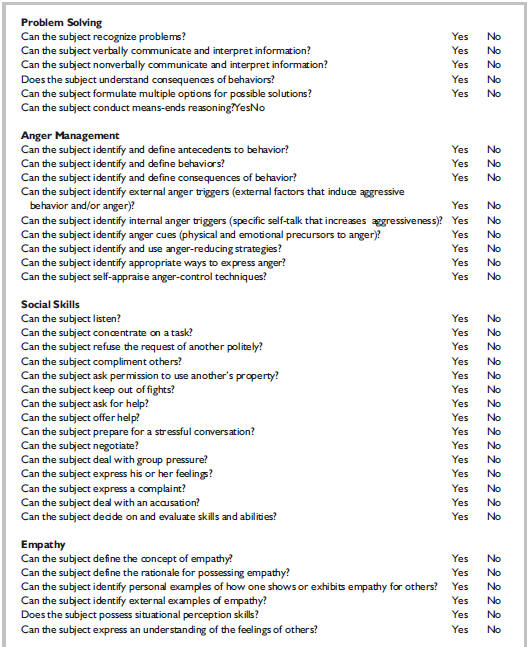
Resiliency Assessment Checklist
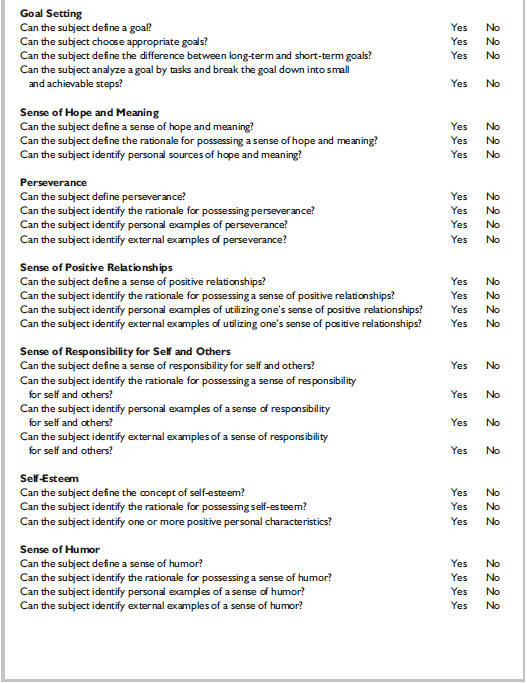
Greg’s success shows that developing resilience is the key to unlocking a hopeful future for youth in need of extra help. The Resiliency Assessment Checklist (see Figure 1) is essential to developing this resilience. This checklist has proven to be a valuable asset for assessing youth in our program. Once we determine a child’s most dynamic needs, it is much easier to help him or her on an individual basis. The checklist was developed by a group of professors and doctoral students from the University of West Florida. It is used with new youth who enter our program to identify the child’s strengths and weaknesses, along with the most viable areas for resilience skill building.
It is imperative to have a relationship with the child prior to completing the checklist. If you attempt to assess the child without really knowing him or her, you will reduce the checklist’s accuracy and usefulness. Once you have determined the youth’s strengths and weaknesses, you can develop an accurate behavior plan with goals, and individualize groups and workshops.
The checklist determines whether or not youth possess skills or aptitudes in many areas associated with resilience. The observer must check the appropriate skills that the individual child possesses. This information can be gained through youth records, observations, and interviews.
Keys to Success
While there are many factors that will enhance or hinder a youth’s ability to become resilient, there are no data to prove that, even in the worst situations, children cannot pull through. Many times, students like Greg know that they are acting inappropriately; however, they are not sure how to change their behavior. They tend to feel that their lives are not worth much and that nothing they could possibly do would make things better (Goldstein & Conoley, 1997). The key to helping these young people is communication-on a personal and individual level, regardless of barriers. This means that youth, educators, and social workers need to be able to locate and discuss specific behavioral areas that are hindering communication (and therefore emotional development). Instruments like the Resiliency Assessment Checklist help us to do this.
A year ago, Greg had not yet undergone the resiliency assessment, and he was on his way to becoming another troubling statistic. The checklist told us that Greg needed to improve his anger management, communication, and social skills. Identifying these areas enabled us to focus on the few that were troublesome, so that Greg did not become overwhelmed and could make profound progress in them over a short period of time. His success shows that it is possible to turn hopelessness into hopefulness, even in the most troubling situations.
Figure 1RESILIENCY ASSESSMENT CHECKLIST
References
Antonietti, A. (1997). Unlocking creativity. Educational Leadership, 54(6), 73-76. Armstrong, T. L. (Ed.). (1991). Intensive interventions with high-risk youths: Promising approaches in juvenile probation and parole. Monsey, NY: Criminal Justice Press.
Brennan, P. A. (1999). Biosocial risk factors and juvenile justice. Federal Probation, 63(2), 58-60.
Briscoe, J. (1996). A collaborative effort: Examining juvenile offenders with mental impairments. Corrections Today, 58(6), 106-110.
Bushweller, K. (1995). What makes resilience? Education Digest. 61(3), 15-18. Cottle, T. J. (1998). The child at risk: The case for the youthful offender. Journal of Education, 180(2), 95-112.
Errante, A. (1997). Close to home: Comparative perspectives on childhood and community violence. American Journal of Education, 105(4), 355-393.
Garbarino, J. (1999). How we can save violent boys. Education Digest, 65(4), 28-32.
Goldstein, A. P., & Conoley, J. C. (Eds.). (1997). School violence intervention: A practical handbook. New York: Guilford.
Guetzloe, E. (1998). Fight, flight, or better choices: Teaching nonviolent responses to young children. Preventing School Failure, 42(4), 154-159.
Johns, B. H. (1998). What the new individual with disabilities education act (IDEA) means for students who exhibit aggressive or violent behavior. Preventing School Failure, 42(3), 102-103.
Lawrence, R. (1998). School crime and juvenile justice. New York: Oxford University Press.
Novick, R. (1998). The comfort corner: Fostering resiliency and emotional intelligence. Childhood Education, 74(4),200-205.
Walsh, F. (1998). Strengthening family resilience. New York: The Guilford Press.


