






































 Listen
Frank Eckles: the Right Person, in the Right Place(s), at the Right Time(s)
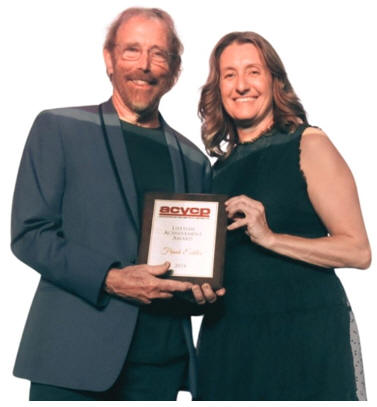
Frank Eckles received a lifetime achievement award from Jody Rhodes, president of the Association for Child and Youth Care Practice.
I had the honor of interviewing Frank Eckles, the 2024 recipient of the Lifetime Achievement Award from the national Association for Child and Youth Care Practice (ACYCP). But, I must preface the following summary of my interview with the fact that I am probably not doing justice to much of the essence of Frank’s words and only capturing a few themes from our discussion.
Early Life
Though was born in the U.S. (Kansas City), Frank spent his early years of life in Germany and later in Panama. Frank’s father was a highly-ranked military officer. According to Frank, his family was a supportive, normal, “dysfunctional family.” When first coming back to the U.S (Texas) as a young child, Frank said that he felt a little “out-of-place” as he started school later than his classmates and many friendships had already formed. In addition, having lived in other countries and cultures, Frank had a different perspective (worldview) of society compared to his peers at that time and place in our country. I wonder if this broader and more diverse view later served as a foundation for his career trajectory. I think he already began to be the “right person, in the right places, at the right times.”
Accidental Pathway into the Field
Frank described himself as the consummate accidental practitioner. He was unsure of what he wanted to do for a living. He took psychology classes but psychology was not exactly what he wanted to do. However, for the psychology program, he went on a field trip from College Station to a psychiatric hospital in Austin, Texas and was “taken by that experience.” He decided that was the place he wanted to be at that time. However, after repeated visits to the personnel office to just “find a job” and not specifically begin a career in CYC, he finally landed a job working with children. Frank stated “that started everything for me. It was where my life changed dramatically because I had never done any work with children. What I didn’t realize was that I had walked into mecca. Of all the places that I could have applied, that was the exact place that I needed to apply. There was something mystical about that! They were on the cutting edge of the public system in Texas.”
Frank found employment in a progressive psychiatric program during the early 1970’s which offered exciting opportunities for learning as well as many challenges. The Children’s Psychiatric Hospital (CPH) had recently integrated, including white patients and patients of color. A de-institutional movement was on the horizon and community outreach had just begun. Although training was provided; there was no training provided by experienced CYC practitioners. Frank remembers “getting some terrible advice about how to work with kids.” He stated that “what I learned working directly with kids superseded what a lot of people that were highly educated knew about how to work with kids.”
Frank was promoted to be in charge of the evening program where he caught hepatitis from one of the young persons and missed work for three months. After his return, he was approached about working on a newly forming team (Outreach Action Team) comprised of child psychiatrists, psychologists, teachers, social worker, nurse and Frank as a direct care worker to help the other eight state hospitals develop children’s programs. While working on the Outreach Action Team, he was exposed to the overall child care system in Texas and realized that there was no professional association for CYCs. Frank worked with about twenty people to form the Texas Association of Child Care Workers. He was the chair of the Constitution Committee that created the organization and became the second President. Over five years, the Texas association became the largest CYC association in the U.S.
In 1975 the CPH was funded to set up a BA/MA program based at CPH (public service system) and San Antonio Children’s Center (private service system). Twenty interns were hired and trained over a two-year period. Second-year people were in supervised field sites in early childhood education, juvenile justice, after school, programs etc. The team hit the ground running with no program and twenty students. However, they were able to create the degree program “on the fly” in conjunction with Incarnate Word College in San Antonio. It was a cutting edge CYC program that trained people to work in any setting. It was likely the first of its kind in the US. Frank became the Assistant Director of the program and stayed for two years to set it up. Both he and the Director left at the end of the second year due to funding cuts that impacted the continuance of the program.
From January 1978 to April 1990 Frank worked at Interaction Associates as a consultant, which allowed him time to do work on his sailboat project. He consulted with a wide range of CYC programs including those with native American tribes, after school, early childhood education, residential treatment and other providers.
In April 1990, he became the Director of Residential Services at Tejas Home for Youth until 1997 when he became the Training Director. It was during this time that the work on NACP occurred. During this period David Thomas, Hector Sapien, Frank and others formed the Texas Youth and Child Care Association. They also established the Child and Youth Care Worker Certification Institute of Texas and began certifying people to work in any setting. They created the Entry and Associate levels of certification and reconnected with NOCCWA to help get the Full Professional credential moving. David became president of NOCCWA and morphed it into ACYCP with the sole mission of producing national certification (a goal that they had been promoting from the 1970s when they helped to form NOCCWA).
Building the Profession
As mentioned, Frank got involved with the CYC association in Texas. He became aware of other state CYC associations and joined a number of colleagues involved in the associations about the possibility of a national association and strategies to strengthen the CYC field. Frank realized that CYC certification should not be limited to a state but should have a national and perhaps an international scope and should not be limited to silo(ed) areas of practice (e.g. residential treatment, day care). A CYC credential could transfer across state, province, and national boarders as well as numerous types of practice settings where the core of CYC practice is conducted. Thus his collaborative work with various local, state and provincial, national and international organizations began.
“Somebody Had to Do It”
Frank talked a bit about the ten-year effort to complete the North American Certification Project NACP). More than 100 CYC practitioners volunteered countless hours of work to develop, research, implement and evaluate the project. There were numerous challenges that project members faced when constructing the certification exam and completing other facets of the certification process. There was one critical period when, after everyone’s multi-year efforts, completing the certification project almost didn’t happen. There was a lack of leadership and the project was floundering! That’s when Frank stepped up and became co-chair of the Concurrent Planning Committee that was created to “pull everything together.” According to Frank, “somebody had to do it.” “There were things that just fell into my lap. It wasn’t like I was particularly smart about it. It was just that...you know...part of it is just showing up and being there. When somebody needed to do it, I offered.”
Frank showed up and he showed up! He often worked all day with young persons and then worked all night for the benefit of the CYC field and emerging profession. As an example, I remember when the certification assessment team was finalizing the first draft of the professional level certification exam. We worked all day reviewing data from a variety of sources and were completely exhausted. Frank, as I know he has often done, worked during the night and returned the next morning with a comprehensive summary of our work from the previous day. The draft certification exam was completed and served as the foundation of the CYCCB certification program. Frank was subsequently elected as the first President of the national/international CYCCB and established the CYCCB office in College Station, Texas. Somebody had to do it! Frank showed up again as the right person, in the right place, at the right time.
Establishing the certification program and the office to administer it was a major milestone for the CYC field and emerging profession. There was “next to no funding” to support the program’s development, research and implementation. The ACYCP sponsored the program’s development with volunteers from its membership and provided some funding to support travel for two in-person work meetings. It also fronted as small amount of funds to help get the program incorporated. But there was no government, foundation, or corporate sponsor that helped to fund the project. It was developed and implemented by U.S. and Canadian volunteers from the field. It belonged to the emerging North American CYC professional community! And Frank’s significant contributions played a crucial role in this achievement. Today, the program has certified thousands of practitioners and its effectiveness has been demonstrated via numerous research studies disseminated in a variety of professional publications and venues. It is the largest international certification program for CYCs in the world.
Helping to Navigate the Journey
When I was preparing for the interview with Frank, I remembered that Frank spent a number of years building a sailboat-just as he was helping to build the CYC profession. And, there are similarities to being the leader (captain/skipper) of a sailboat and CYC leadership qualities. A quick Google A.I. search identified a few parallels.
Vision
One must have a clear destination in mind when sailing and be able to communicate to the crew.
Frank was one of the first to recognize that professions do not define themselves by practice setting, client characteristics, or funding source. Professions define themselves by their body knowledge and methods of practice (including ethical standards). It should also not be limited by where the practice occurs (e.g. city, state/province, country). The core CYC knowledge, skills and values are similar whether one practices in day care, residential, after school, etc. And core CYC practices transcend geographic boundaries. Frank helped me and many others to recognize his vision and the possibility of a more unified CYC profession. When unified, CYC could be the largest human service profession.
Patience and Persistence
Arriving at a destination takes time. Frank said he is not a patient person but he is very persistent. He said he “had to learn that what looked to me to be about 5 years of work was actually a career-long adventure. Many people tried to tell me this but I wasn’t able to hear them. I often questioned my own abilities but I never questioned the importance of what our community was creating. I feel a great sense of pride at being able to work with so many people over so long a period of time to move the field of CYC into recognition as the profession we know today.”
Courage
It takes courage to venture out where there may be no land in sight.
In the interview Frank mentioned that he was somewhat intimidated by others at times who had higher and more recognized professional credentials (e.g., Those with doctoral degrees, agency directors, college professors, researchers, journal editors). He was a direct practitioner and had the courage to provide his important perspective. Frank later took the risk to co-chair the Concurrent Planning Committee and step up to become the first president of the CYCCB to establish and administer the CYCCB office.
Building the Crew
The leader of a sailboat must empower the crew to fulfill its tasks as well as prioritize their well-being.
As CYCCB President, Frank prioritized team building. The importance of hearing everyone’s input and consensus-building was essential to him and a major factor for early and ongoing success of the program. For Frank, team building seems to be a part of his core CYC methods beyond his work with the CYCCB. For example, I know that he continues to periodically participate in team building with young persons on Challenge (adventure) Courses. It takes a little bit of courage to do that as well.
Reading the Environment and Weathering the Storm
A sailor must be in-tune with the environment (e.g., water, wind and sky) to anticipate and deal with challenges and setbacks.
Frank helped the CYCCB recognize many of the challenges of initiating and administering a CYC certification program across the varied fields and practice and geographic boundaries in North America. While there is a common core of CYC knowledge and methods, there are also many unique aspects of practice in the varied settings. Frank emphasized the importance of understanding and appreciating these differences while emphasizing our common bonds.
Mentioned above is an example of how Frank helped the NACP “weather the storm” by taking on the role of co-chair of a crucial committee. Frank volunteered for all the NACP committees so that he could figure out how to keep them moving and integrated.
Recognizing the Contributions of Others
Throughout this column, I have emphasized Frank’s contributions, But he has always recognized, appreciated and given credit to the collective efforts of others. As mentioned, I wonder if his early experiences of living outside of the U.S. helped to prompt his ongoing appreciation, understanding, and propensity for recognizing the importance of diverse voices.
Frank and his colleagues have helped thousands and potentially millions of current and future CYC practitioners become recognized as important professionals. Interestingly, Frank asserted “most people don’t have to create certification programs so they can become be credible.”
A Few of Frank’s Other Achievements
The amount of space for this column does not permit a more comprehensive listing of Frank’s CYC Achievements. So only a few are listed below in bullet format.
Frank “showed up” to help build the CYC profession over and over again. He volunteered countless hours and contributed a significant amount of his personal funds to activities in support of the CYCCB, ACYCP and many other CYC workforce advocacy causes. He was the right person, in the right places at the right times.


