






































 Listen
The use of daily life events to facilitate change is the foundational characteristic of a Relational Child & Youth Care (CYC) approach (Garfat et al, 2018).
Fritz Redl (1959) said that working with young people involves “exploiting" the events that occur during the daily life of a child in care, for the benefit of the child. In other words, we should focus on the ‘daily life events’ as they occur and use these events to help the young person explore alternative ways of living in their world. This was one of the earliest references to the importance of Child & Youth Care practitioners’ engagement with young people in their everyday lives. Indeed, Redl & Wineman (1951, 1952) also suggested that the people who have the most influence on troubled children are those who spend their days with them, engaged in the daily events of their lives: the childcare workers.
“The utilization of everyday processes of living, from awakening to the last “good night,” occur while playing, working, learning, having fun, facing stress, or just being together. They are the Child and Youth Care workers central avenue of service" (Maier, 1995, p.11).
Maier (1987) encouraged us to attend to and use “the minutiae of everyday life”, the small, seemingly unimportant events, out of which the days of our lives are constructed: things like bedtimes, going for a walk, watching a movie together of engaging in any other simple act of connectedness (Garfat, 2025). It is in these everyday experiences that we create the context for healing (Fox 2003). In speaking about the child and youth care worker’s engagement in the daily life events of young people, as early as 1977 Maier said that child and youth care workers are the most powerful agents in the children's lives and that it is the child caring person's continuous interaction with the child that counts.
So, as the elders in our field have long suggested, the purposeful use of daily life events, as they are occurring, is the powerful foundation of Relational Child and Youth Care Practice (Garfat 1998; Garfat et al, 2024). Nothing else is so basic and so historic to our approach.
Relational Child and Youth Care practice involves using the everyday, seemingly simple, moments which occur as CYC practitioners live and work with people to help them find different ways of being and living in the world (Garfat et al, 2024; Maier, 1987). Relational Child and Youth Care practitioners are defined in their work by the way they make use of these moments (Garfat et al, 2018).
25 characteristics of a Relational Child & Youth Care approach (Garfat et al, 2018) have been described. And all these characteristics are important. However, I wish to make a subtle distinction.
The characteristics about how we know, act or be in our interactions using daily life events to facilitate learning, development and healing are important – and we might note – that they are all surrounding the 25th characteristic – using daily live events to promote change.
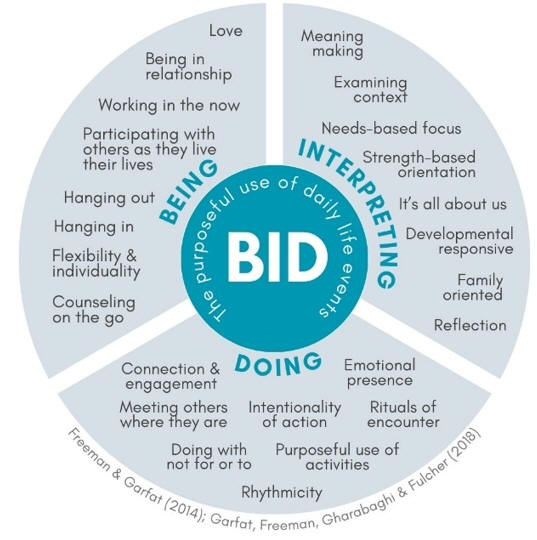
It is to this 25th characteristic that I address myself.
Life is filled with simple events – not just the normal events we think of, like mealtimes, bedtimes, engagements, etc., but also the even more simple events, like when a child drops a pencil, or burps at the table, or, even, laughs at something painful. These are small, almost insignificant events of the everyday. They are there, everyday, for all of us, not just for the young person in care.
And, as CYCs we are constantly wondering “how can this seemingly simple little moment be made meaningful or significant in our work with this young person?”
This must be the ultimate question for the Relational CYC Practitioner.
Here are three questions which might help us think about how to respond to these seemingly insignificant moments:
How do I understand this moment?
We all need to make sense of our experiences. It is only when we make sense of something that we act, based on our understanding of what we are experiencing in this moment. So, a child in the classroom drops a pencil, and we, if we are actively engaged, wonder what meaning there might be here. Do they drop the pencil as an accident, is it an act of defiance, is it a call to be noticed? What sense do I make of this momentary action? And based on our interpretation of this moment, we act (respond). While ‘dropping a pencil’ may seem like an absurd example, it represents how we, always, make sense (interpret) our experiences. Imagine that you ask a young person to come over and talk to you. They interpret your action and mased on that interpretation, they act – perhaps they come closer, perhaps they move further away.
Understanding (making meaning of) this moment is influenced by our history, education and previous experiences. All our previous experiences come into play as we wonder about this moment (if, indeed, we wonder at all). And there-in lies the rub. If we are not aware and self-aware, we may not notice that we are interpreting this moment in the way that we are. Making meaning is often a sub-conscious activity. Whether we recognise it or not, we are constantly making meaning of everything. Our objective as CYC professionals is to bring our subconscious interpretations into our consciously awareness. Thus self, and self-awareness, are central to the ‘purposeful use of daily life events’.
So, in any moment we are wondering ‘how am I understanding this moment?’
How might this moment be related to the goals we have established?
When we work with young people (and their families) we establish goals (hopefully together) to help the young person function differently (less painfully for themselves and others) in their world. These goals guide our everyday interactions with young people.
Goals, of course, are a statement of how a person will be, or how they will act in their world at a certain point in time. They are, quite simply, the endpoint of our work together.
When a moment occurs – and there are many of them everyday – we wonder ‘how might this moment be connected to the goals we have established’?
For example, a young person is working on ‘finding voice’ – learning to express their thoughts, opinions, desires, etc. A moment comes when they want or need something, and we wonder, “how might this moment be connected to the overall goals we are working towards together”? If we are not constantly asking this question, then we are not focussed on the endpoint – for the young person to be living differently, and less painfully, in their world.
Not all moments are related (connected) to the goals we are working towards, but it is our desire, as CYC workers, to identify those which might be connected to these goals and then engage meaningfully with these moments. Every moment has the possibility of helping the young person take one step towards their goal – and always we wonder if this is one of those moments.
How might we make this moment as meaningful as possible?
This is the ultimate question for those of us who believe in the purposeful use of daily life events or moments. And while the foregoing suggests that the ultimate response is to connect this moment to the goals we have established, the reality is that not all moments might be connected to those goals. Yet, it is still our desire to make these moments meaningful.
While, theoretically, every moment could be connected to the established goals, the reality is that we do not always see the connection. And yet, even without seeing the connection, we work to make every moment meaningful.
Let’s go back to the young person dropping the pencil and assume that this young person is working on not being so aggressive in interactions with their peers. We cannot see any connection between this young person’s goals and dropping the pencil – and maybe there is no connection to be found – although I am certain that some of you can make a connection.
So, assuming we cannot make a connection, how can we make this moment meaningful?
This is the ultimate question. So, let’s speculate, given that we, as readers, do not really know this young person. Here are some questions we might wonder about:
And there are a multitude of other responses, all of which might find a way to make this moment meaningful with this young person. The options are only as limited as our imaginations. But only if it is our determination to make every moment as meaningful as possible.
Which is, of course, our job – to make every moment as meaningful as possible for the young people with whom we are working.
Conclusion
Our job, as CYC professionals is to make every moment as meaningful as possible, whether that means connecting to a goal we have established together or finding other meaning in the moment. If we care, we act – and we act to make every moment meaningful. The young people with whom we work have often lived a lifetime of pain and so as we make moments meaningful, we move to eliminate that pain. Each moment represents the opportunity to take one small step forward to learn how to be and respond differently in their world.
References
Fox, L. (2003). Exploiting daily life events to heal the pain of sexual abuse. CYC-Online (52). The CYC-Net Press.
Garfat, T. (2025). Reaching out. CYC-Online (314). The CYC-Net Press.
Garfat, T., Gaitens, C., Hadley, J. & Legget, A. (2024). Relational Child and Youth Care Practice: What it Means to Us. CYC-Online (299).
Garfat, T. (1998). The effective child and youth care intervention: A phenomenological inquiry. Journal of Child and Youth Care, 12 (1&2), 5-178.
Garfat, T., Freeman, J., Gharabaghi, K. Fulcher, L., (2018). Characteristics of a relational child and youth care approach revisited. CYC-Online, 236 pp 7-49. CYC-Online October 2018 (cyc-net.org)
Maier, Henry W. (1995). Genuine Child Care Practice Across the North American Continent. Journal of Child and Youth Care, 10;2 11-22.
Maier, H.W. (1987). Developmental group care of children and youth: Concepts and practice. New York: Haworth Press.
Maier, H W (1977) The Child Care Worker. In J. B. Turner (ed.) Encyclopedia of Social Work. New York: National Association of Social Workers.
Redl, F. (1959) The Concept of a 'Therapeutic Milieu'. American Journal of Orthopsychiatry 29: 721-36. Also in G. H. Weber and B. J. Haberlein (eds) (1972) Residential Treatment of Emotionally Disturbed Children. New York: Behavioral Publications.
Redl, F. and Wineman, D. (1951). Children who hate. The Free Press: New York.
Redl, F and Wineman, D. (1952). Controls from within: Techniques for the treatment of the aggressive child. The Free Press, New York.


