Supported by







































 Listen
Relational Child and Youth Care practice should not be a difficult concept to understand. It simply means that for a Child and Youth Care Worker to offer any therapeutic intervention, a relationship must first be built with the young person. From the very first contact both the Child and Youth Care Worker and the young person begin a process of sizing each other up, trying to figure out the obvious traits each one carries.
We gather information through body posture, tone of voice, facial expressions, and sometimes even scars or marks on the body. From these observations, we often form quick, prejudiced conclusions, many of which we later discover were wrong.
It’s natural for any human to become cautious when a stranger enters their space and their life. We must remember that this applies equally to children and their families. Our good intentions do not automatically qualify us to be trusted. Trust must be earned through rapport.
Relationship as the Foundation
While the end goal of our interaction with children is therapeutic support, this can only happen when a solid relationship has been built (Phelan, 2003). Facilitating this relationship is the responsibility of the Child and Youth Care Worker. A young person will allow a worker into their lifespace depending on the level of trust established between them.
In many situations, Child and Youth Care Workers manage behaviour through the strength of their relationships. For example, if a young person behaves in a way that is not allowed, the team will often assign the worker who has the strongest relationship with that young person. That worker is more likely to succeed in helping the young person regulate. On the other hand, if a worker has no relationship with the young person, managing inappropriate behaviour becomes much more difficult.
Meeting Each Other
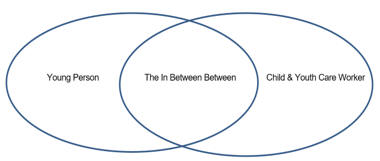
For the relationship to be experienced, both the young person and the Child and Youth Care Worker must be willing to meet each other halfway. Thom Garfat refers to this shared space as the “in‑between between” (Garfat, 2008).
A simpler way to understand this concept is to imagine yourself alone in your personal space. When no one else is present, you enjoy a level of comfort that makes it easy to exist with your surroundings. But the moment you allow another person into that space, you begin to share it. Sharing space (physically or emotionally) creates closeness that can disturb the comfort you had when you were alone.
For harmony to exist in this shared space, both the Child and Youth Care Worker and the young person must temporarily set aside parts of themselves. The worker sets aside personal beliefs and steps into their professional self. The child may set aside their true behaviours or habits and behave in a way they think will please the worker. In this moment, neither person is fully themselves. Both have stepped halfway out of their personal selves to meet halfway. That halfway space is the “in‑between between”.
At the point when the child becomes comfortable around the Child and Youth Care Worker, healing can begin to take place. Each young person reaches this point at their own pace. Our role is to be patient and allow them to arrive in their own time without attempts to hurry them up. As the child and worker coexist in this space, both over time learn to be comfortable with each other.
Ingredients That Strengthen the Relationship
As Child and Youth Care Workers, we remain cognizant that the relationship is the vehicle that brings us closer to children and drives healing in our work with them and their families. To build and nurture this relationship, the worker must add ingredients such as trust, honesty, loyalty, integrity, consistency, and respect. These qualities demonstrate our commitment to the young person.
We should also remember that many of the children we work with have been disappointed by adults many times in their lives. They approach new relationships with hesitation and reluctance to protect themselves from further hurt. If we are inconsistent with the ingredients mentioned above, we make it even harder for them to trust us.
Professional Boundaries
The nature of this relationship must always be professional, never personal. There are some characteristics that must be in this relationship, for example, it must be time bound and guided by a code of ethics. Children will relate to us based on the depth and quality of the relationship we have built with them (Phelan, 2003b).
Relationships should begin forming from the very first engagement. It is helpful to reflect on the relationships we have with each child: How strong or weak is each relationship? What has each relationship allowed you to do—or prevented you from doing—alongside that young person? Which relationships would you like to strengthen, and for what purpose?
We are the professionals in the relationship with the responsibility to coordinate the pace at which the relationship develops. We must respect ethical boundaries and ensure that every relationship with a child or family is aimed at their best interest, not our own personal needs.
Child and Youth Care practice begins the moment we meet a young person and start that natural process of seeing who they are and allowing them to see who we are. It is at that first contact where both the worker and the child begin the journey of understanding and connection.
Garfat, T. (2008). The inter-personal in-between: An exploration of Relational Child and Youth Care practice, In G. Bellefeuille, and F. Ricks, (Eds) Standing on the precipice: Inquiry into the creative potential of Child and Youth Care Practice, (pp 7-34), MacEwan.
Phelan, J. (2003a). Creating safe relationships. CYC-Online, 54.
Phelan, J. (2003b) The relationship boundaries that control programming. Relational Child and Youth Care Practice, 16(1).


