
































Practitioners and policy makers have become increasingly aware of the importance of language used around children and young people within the care system. Existing research on young people and labels largely focuses on the impact of diagnostic labelling. More general explorations of how care experienced young people perceive labels calls for in-depth qualitative enquiry. This study aimed to elucidate how young people and the workforce experience labels in a secure and residential service using grounded theory and ethnographic methods. Researchers were full-time psychology staff within the host organisation with an already established nurturing relationship with participants which allowed for a rich view of their shared experience. The study finds that young people and the adults working to support them perceive that much of the everyday language they experience are labels which they often regard as negative and not conducive to empowerment. The findings provide insight into the issues within the Scottish care system and present an opportunity for improvement with the need for minimal resources.
Keywords
Secure care, grounded theory, labels, hopelessness, residential care, Scotland
Introduction
Labelling is a phenomenon certainly not limited to residential childcare. It is known that if wine is labelled ‘sweet’ tasters are more likely to discern sweetness than they are in the same wine labelled differently (Pohl, Schwarz, Sczesny & Stahlberg, 2003). Classic sociological labelling theory (Hecker, 1965) posits that individuals’ self-identity and behaviour could be influenced, or even determined, by the language used to describe, classify, define and portray them. There is no escaping the use of labels in residential childcare; whether we refer to children as ‘care experienced’ or ‘looked after’ or use clinical diagnoses to define characteristics there is little known about the impact of such labels within the care system.
The Independent Care Review (2020) in Scotland has highlighted that outcomes for children and young people who are care experienced are less positive than non-care experienced peers and recognised that much of the language used by adults and professionals around the care system is potentially stigmatising.
Mannay et al.’s (2017) Welsh study sought to understand the lived experiences of children and young people using qualitative methods to explore the educational ‘consequences of being labelled “Looked After’’’; providing essential insight. However, data collection took place over only three days so may have missed the opportunity to gain a full picture of the young people’s perspectives meaning more research is required to gain a fuller understanding of experiences (Mannay et al., 2017).
It is widely known that care experienced children are more likely to hold one or more diagnoses (Klein, Damiani‐Taraba, Koster, Campbell & Scholz, 2015; Ford, Vostanis, Meltzer & Goodman, 2007; Stanley, 2007). The literature around children and diagnostic labels is conflicting, with some claiming diagnostic labels are helpful (Clark, Vinen, Barbaro & Dissanayake, 2018) and some unhelpful (Moore, Russell, Arnell & Ford, 2017). More specifically for the ‘looked after population’ there is research around the explicit need for mental health support (Doyle & Cicchetti, 2017; Stanley, 2007) and the argument put forward that there is a need for developmental trauma, prevalent for this population, to be considered as a diagnostic label (Van der Kolk, 2017). However, there is a dearth of recent inquiry into the related views of young people in care and the professionals around them (Miller & Baxter, 2019).
Given the broad range of enquiry into labels and care experienced young people, the evidence of generally bad outcomes within the population (Care Review, 2020) and the apparent link between this and stigmatising language within the care system it is important to gain a grounded understanding of the experience of young people in care. For children and young people, the family system is an essential context in which all experiences take on meaning (Erdem, Gizem & Safi, 2018). For children in care, members of staff undoubtedly form an important system within which they experience life and find meaning. As such, it is also important to gain insight into the views of staff in the care system when trying to better understand how young people in care experience labels.
This study sought to help understand what labels are important to young people and workers within the care setting; to find out how labels may relate to the young people’s feelings of being supported and the workforce’s feeling of being equipped to provide support. This was important, principally because there is a consensus that the Scottish care system fails in many ways. Therefore, there is a drive to understand exactly why that is and how it can be changed (Independent Care Review, 2020).
Qualitative research by Stanley (2007) used grounded theory methodology to effectively highlight the unique mental health needs of care experienced young people by uncovering the perspectives of young people in care, their views and the views of their carers. The link between practice and real experience is evidently strengthened by this type of research as it is now commonplace for young people in care to be offered mental health support and for care providers to have direct links to NHS Children and Adolescent Mental Health Services.
Subjects of this nature are often best explored using techniques free from pre- determined hypotheses (Charmaz, 2017), enabling themes to be understood, explored and defined. Thus, a sensitive approach whereby researchers can seek to understand meaning from data is required for answering the present research question. The scarcity of research that gains rich insight into the lived experiences of young people and practitioners in secure and residential care gives precedence to developing research practices which use the qualitative methods most conducive to exploring experiences: ethnographic inquiry and conversational interviewing (Miller & Baxter 2019; O’Neil 2001; Emond 2000). It is important to gain information from participants and for the understanding of phenomenon to be developed as the data is gathered without methodological constraints.
Snyder's (1994) Hope Theory was used as a theoretical framework throughout the analysis process. It posits that in order for hope to flourish a ‘sense of successful determination in meeting goals in the past, present and future’ must be facilitated (Snyder, 1994). The second component of this cognitive set of hope is, ‘the sense of being able to generate successful plans to meet goals’ (Snyder, 1994).
Houghton (2015), in a review of literature about young people’s involvement in research and policy making, found that it was essential that young people are empowered to share their experiences to be able to effect change on the issues relevant to them, such as domestic abuse. The current study empowers young people by enabling them to explore their views on the everyday language used around them and also uncovers theory about experiences which is useful for policy makers and practitioners to reflect on. Houghton (2015) also stressed the importance of researchers being equipped to deal with young participants’ distress and any disclosure that may arise; this was ensured throughout the current study by working within the GIRFEC framework (Scottish Government, 2019) and because of the substantial clinical experience of the researchers.
Methodology
Epistemology
Grounded theory research is free from pre-determined hypotheses and asks a number of qualitative questions to determine information from participants and reach theoretical saturation. Findings should be led by the participants’ realities and the researcher must be sensitive to the data (Charmaz, 2017).
The position of the researchers of the current study within the host organisation - and therefore as a part of the participants everyday life - gave data collection a valuable ethnographic dimension (Charmaz, 2014) which garnered an inclusive understanding of views which have been underrepresented (Miller & Baxter 2019; O’Neil 2001; Emond 2000). Ethnographic inquiry goes beyond regular qualitative methods, allowing for the whole atmosphere and aggregate life occurring in it to be taken into account (Charmaz, 2014).
Participants
Participants were adult staff and young people (aged between 12 and 15) at a secure and residential service for young people in Scotland. The service accommodates up to 18 young people in the secure campus and up to 14 in the residential service and there are around 160 members of staff employed across care, education, specialist services (including psychology, nursing and through care-aftercare) and housekeeping and administration.
The current study was ethnographic; data collection took place over several months, with 12 days of focused data collection; the researcher was not a stranger and participants were made aware that they could choose to meet again if they felt they had anything else to add to their responses. As a result of this ethnographic style of enquiry the data and analysis are unique and highly conducive to gaining a full detailed insight into the young people’s experiences.
Every member of staff in the organisation was invited to participate by email and young people were informed of the study orally; all participants were informed that their decision to take part or not had no impact on their placement or employment. No rewards or biases for taking part were offered.
Demographic information pertaining to each individual participant was not obtained. In Perspectives in Clinical Research, Shivayogi (2013) asserts that vulnerable populations should be treated sensitively and protected by researchers. It was judged that seeking demographic information may make both adult and young participants uncomfortable or wary of the researcher, so the decision was made to avoid asking participants for demographic information. Griffin and Bengry-Howell (2017) set out the importance of the researcher- participant relationship in ethnography, citing a positive relationship where the participant does not feel pressure to fulfil requirements for the study as vital for good research. It was therefore epistemologically congruent not to ask young participants to provide demographic information or to seek permission to do this through file reviews. This epistemological position was also ethically significant as effective reflexivity is conducive to best practice in responding appropriately to ethically important moments that can arise unexpectedly when conducting research with young people (Graham, Powell & Taylor 2015).
Formal participants who took part in semi-structured interviews were four young people (n=4) across both the secure (n=3) and residential settings (n=1).
Formal adult participants (n=5) consisted of members of staff, within their first two years of employment in the organisation (n=3), and having exceeded 10 years of service for the organisation (n=2).
The researchers were employed by the host organisation during the process of the research although the aim of the project was to add to the growing research in care experiences rather than to fulfil any service objectives. As such, Charmaz (1990) suggests that as the researchers were embedded in the field of enquiry, they have been influenced by members of staff and young people who, though not formal participants, have shaped the theory which has been constructed rather than discovered.
In concordance with grounded theory methodology researchers acknowledged their experience and standpoints as practitioners throughout the process of inquiry. As a forensic psychologist and an assistant psychologist regularly working therapeutically with young people in the service, and beyond, we felt well positioned to gain the trust of the young participants and enable them to share their views; being mindful of the potential for a perceived power imbalance and making it clear that there were no right or wrong answers or obligations. We were also well practised in reflecting on our own views which was of particular importance during the analysis process.
Design
Interviews were obtained over three months. Each interview was semi- structured and included variation in questions in line with theoretical sampling. As such, after one interview had been conducted and subject to an initial phase of coding and analysis, the interview schedule for the following participant would contain new open-ended questions based on observations emerging from initial analysis in order to follow a line of enquiry during the process of coding and analysis which coincided with data collection. However, within each interview the aim of the study was consistently presented to participants and core questions to ensure data collection was open to all kinds of labels and experiences were used. One interview was a group interview with two young people who found one-to- one situations uncomfortable. The flexible ethnographic nature of the study and the knowledge the lead researcher had of participants meant there was a particular ease in facilitating a group interview; allowing these individuals to share their views where they may otherwise not have felt supported to.
Procedure
Analysis and data collection took place concurrently. Data was continually subject to an open coding process: line by line descriptive analysis which was repeated across data before being conceptualised, giving rise to emerging categories which are detailed in the analysis section and which were integrated to form the grounded theory (Walker & Myrick, 2006). Memos, an integral part of the grounded theory method, were used throughout data collection to foster an advanced analytical process and reflexivity (Willig, 2008). Memos were the researchers’ written record of theory development and were a vital analytic step between coding, categorising and presenting theory (Strauss 1987; Charmaz 2006). Writing memos at all stages of the data collection process allowed for straight forward comparison of codes and categories and, in turn, meaningful analysis. This cyclical process of data collection and analysis was central to the researchers’ recognition that saturation was reached; no new concepts were emerging and finally the theory was uncovered (Willig, 2008).
This research was conducted under British Psychological Society code of ethics and the host organisation’s most current guidance on conducting research, including a process of application for approval by the Board of Governors. Ahead of research, prospective participants were given plain language statements, offered the opportunity to have the statement read to them and given time to reflect on the statements before being presented with a consent form.
Participants’ right to withdraw from the study at any point was made clear and they were reminded of this throughout the research. Consent was a process rather than a onetime agreement. Although the participating organisation may be identifiable, and confidentiality cannot be unassailably guaranteed, every effort has been made to respect each participant’s confidentiality; no names or identifiable information have been obtained. The permission for this research to take place was fully granted by the organisation and it is understood by them that great care will be taken with participant data which will be kept on their secure drive.
Analysis
The analysis revealed the effect on young people and the workforce of everyday language within the care setting. The aggregate theory of this research is presented and clarified by the component categories and sub-categories. A summary of this is presented in Figure 1.
Theory
Labels Cause Hopelessness in Young People and the Workforce in Secure and Residential Care
The theory represents a conceptual link between all categories and sub- categories within the analysis. It centres on the internalisation of labels in secure and residential care that is experienced by young people and mirrored within the experiences of the workforce. Hopelessness arose from participants’ perceptions and internalisations of the language used around them, broadly due to a sense of powerlessness, helplessness and a lack of clarity.
Figure 1: Summary of theory including component categories and sub-categories
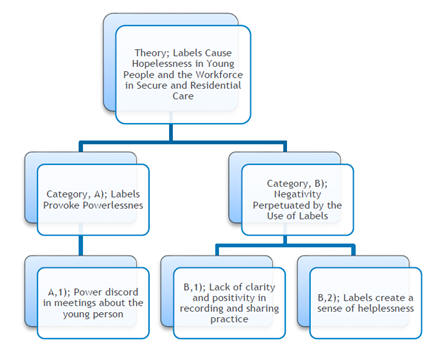
Category A: ‘Labels Provoke Powerlessness’
A.1) Power discord in meetings about the young person.
Both professionals and young people communicated a feeling of loss of their warranted power through their experience of labels in professional meetings held to discuss and make decisions about the young person. Each young participant shared these feelings and care and through-care participants reflected this.
A young person described having the knowledge that the meeting is, ‘all about you’, and that it is important to attend to have the chance to be involved in decision making but that the over-riding feeling was of awkwardness and a lack of influence (young person 6, 14-19). The young person highlighted the imbalance of power in these meetings through the use of professional labels such as ‘LACS [LAC-R]’ (Looked After Child Review) and Secure Care Reviews:
There was three people in the panel, four other people in the room and it was just decided whether I should be in secure or not. If they didn’t call them LACs it might be better because I didn’t [know]. Some kids might not know what that means. Or sc... sc... secure care review – SCR – how would we know what that is? (Young Participant 6, 10-24)
It appears meetings are important to young participants; they are acutely aware that decisions made wholly affect them, but it seems they also feel that the meetings do not accommodate their agenda and understanding well enough.
Another young participant recognised the challenge of the professionally generated labels around meetings: ‘you need to be here a month or two before you learn about it all’ (Young Participant 7, 56-57). They appeared wearied by professional meetings while sharing the number of meetings they had attended in recent months. Also illustrative of this was the theatrically bored tones in which one young participant listed the professional labels for each type of meeting (Young Participant 7, 5-6). This weariness seemed to pair with a sense of feeling alienated by those who make decisions and their perception of the arbitrary nature of meeting secure criteria. ‘Meeting secure criteria’ is a label often applied which does not inform an understanding of its components, especially for young people. In a group interview a young participant asked another, ‘Do you meet secure criteria? I don’t but I’m still in secure care’, (Young Participant 7, 55-56). When asked why that was the young participant shrugged their shoulders and said they didn’t know.
Staff member participants agreed with young participants in terms of the unsuitability of meetings for young people in the language used and the prominence of professional and legislative labels such as ‘LAC’ [Looked After Child] and Secure Care Criteria. A care staff participant felt that they are most aligned to the young person in any meeting as it is their job to support them and care for them. There is a commitment to the young person; they feel compelled to support the young person to understand but don’t always feel they have the power to do so. Staff participant 2 described the challenge it can be to take up space in the meeting to ensure the young person has understood what is being discussed:
Not every person would feel comfortable stopping a meeting where, you know, you’ve got a psychiatrist, a social worker, a mental health nurse, you know you could think, ‘Hmm, I’m kind of down the pecking order in this hierarchy of professionals.’ (388-393)
This highlights the imbalance of power observed by care staff and young people in the realm of meetings; they perceive that there are more important people in the room than themselves even though they don’t believe this should be the case. There is reasonably an ensuing feeling of hopelessness in experiencing this perception. The second component of Snyder’s (1994) cognitive set of hope is, ‘the sense of being able to generate successful plans to meet goals’. Since care staff and young people feel that the power in making plans is held by others, they do not experience hope, rather, hopelessness.
Category B: ‘Negativity perpetuated by the use of labels’
B.1) Lack of clarity and positivity in recording and sharing practice.
Each professional participant had a perception of there being a lack of use of positive labels and this is reflected by a general feeling which young participants shared that the labels they experience are mostly negative. Members of care and teaching staff reported a lack of sharing positive staff practices, interventions and behaviour. Staff participants reflected that they found this particularly challenging during which times they were new in post.
B.2) Labels create a sense of helplessness.
There was a general consensus between adults and young people that goals were sometimes created around the young person but not by them. For example, one adult participant shared a view that while young people in the care setting don’t have the emotional or language literacy to understand what ‘nurture’ means it is always included in their care plan in terms of goals and actions. This appeared to cause frustration from the adult participants who felt their success was measured in terms of goals which are not completely specific to the individual young person being ‘ticked off’. They shared a drive to support the young people’s understanding and help carve suitable paths for specific goals but did not feel the structure in which they work enables this as well as it could. Thus, goals can become labels rather than something the young person can internalise a realistic and achievable path towards, facilitating hope.
Another challenge staff that participants shared was the lack of clarity in the language used in reporting, especially incident reporting. Behaviour labels such as ‘heightened’ and ‘aggressive’ frustrated staff participants, as they all felt that they were ambiguous, holding various meanings for various members of staff.
Conceivably this uncertainty around the meaning of the language of colleagues might reduce the extent to which staff members feel confident that those around them will be able to understand and support the positive language essential to work towards goals and engender hope. When procedure appears to support the use of language that does not connect to unambiguous meaning, confidence in the effect of positive and personal goal orientated language appears reduced.
The imprecise meanings gained from negative behaviour labels combined with a perceived under-reporting of positive behaviour labelling and trauma-informed practice seemed to create a feeling of helplessness among the adult participants. One staff participant recounted a specific incident in which they recognised several good pieces of trauma informed practice but felt this was not the focus of the procedural information sharing post incident; rather the ‘disobedient and ‘defiant’ behaviour was the focus.
Sometimes in incident reports or handover forms we don’t always put in the detail that maybe should be there; we don’t say enough, how we’re trauma informed. For example, last night we spent at least half an hour talking to someone about going to their room before they went there... I would say that’s trauma informed because we’re not just putting them to their room [which could be interpreted] as a punishment. It’s trying to work out: ‘Why are you not wanting to go to your room? What is it that’s going on for you? Is it that you don’t want to be alone or don’t want to do something? Is it, triggering a flashback? What is it?’ And those three separate chats prevented three separate restraints happening and that was useful. (Staff participant 2, 192-207)
The perception of the staff member is that people become more focused on the negative behaviour than the positive trauma informed strategies which hold the greatest value in improving the outcomes of future potential incidents. There was a consensus among staff participants that the negative labels received the most ‘airtime’. Each participant mentioned the importance of trauma informed practice and highlighted the discrepancy in frequency of using negative behaviour labels and positive ones including trauma informed practice and language. Trauma informed practice emerged as a shared goal among staff participants. It appears that the lack of reporting usage and successes, the active reviewing of the goal, reduces the sense that their practice has impact, perpetuating a sense of helplessness.
Discussion
A grounded understanding was gained of lived experience of the young people and the workforce in a secure and residential service in relation to labels of any kind, uncovering what labels mean to them and how the use of labels may affect them. Through conducting ethnographic data collection and simultaneous analysis, in an iterative process (Charmaz, 2014) talk was analysed to construct abstract analytical categories which were then applied across data to produce the theory of ‘labels cause hopelessness in young people and the workforce in secure and residential care‘.
In line with a constructivist grounded theory approach, we did not set out to pursue a specific empirical topic when developing theory (Charmaz, 2010, 2014). As such, this study is not restricted to building on labelling literature, rather it is intended to enrich the landscape of explorative literature on the experiences of young people and the workforce within secure and residential care. In essence the theory produced through this study explains how young people and the workforce in secure and residential care respond to the language commonly used around the, their experiences and consequential interpretations and internalisations of ‘everyday language used within the care setting’. The research displays the fundamental significance of labels, the disharmony between the everyday language used within the care system and the essential role, described within scaffolding theory, of adults to appropriately support a child’s development in terms of adjusting interactions according to a young person’s ability (Mermelshtine, 2017; Wood, Bruner & Ross, 1976).
The study was open to any type of label or language yet labels with positive connotations were scarcely perceived by participants. While the young people within the study reported a total absence of any label they perceived as being in any way positive, the members of staff identified that trauma informed language constituted a positive label, but all were focussed on the precedence of negative types of labels over these. The overarching negativity which arises from the experiences of labels within this setting can be validated through a trauma lens, specifically concerning the effect of trauma on the ‘internal working model’ (Hawkins & Haskett, 2014). An insecure attachment, which is a common manifestation for individuals in care who often have traumatic backgrounds, adversely influences an in individual’s internal working model (Suzuki & Tomoda, 2015; Naismith, Zarate Guerero, & Feigenbaum, 2019; Van der Kolk, 2017). The internal working model has implications for how one experiences and perceives themselves, others and the world around them (Van der Kolk, 2017). Thus, the influencing of an individual’s relational style: it is relied upon to determine how others think, feel, act and intend. Van der Kolk (2017) explains that an underdeveloped internal working model leads to children believing they are, ‘unlovable/wrong/bad/unworthy of love and affection or care', perceiving adults as abusive/harmful/unavailable/ unreliable’ and the world as ‘frightening/unpredictable/inconsistent/ harming’. It is important to consider that the young people in this study were predisposed to having a negative view of the world in order to better understand the analysis.
Principally the analysis found that participants were deserted by the labels they experienced as most significant. The labels that both young and adult participants perceived as common, as significant to them, lead to provocation of powerlessness, negativity and ultimately a hopeless view of themselves and the future. Lambert and Lambert (1981) related classic sociological and social- psychological role theory (Turner, 1978; Lindsmith & Strauss, 1968) to the concept of powerlessness in a health context. Role theory posits that the individual identifies their role by going outside themselves and taking on the perspective of others (Lindsmith & Strauss, 1968). Lambert and Lambert analysed clinical observations and found that when patients felt unable to take on the role of the ill person as it was perceived by those around them, they experienced powerlessness. This supports the discordant experience of the participants in the current study; the professional labels they hear represent to them how they are perceived by those external to themselves and the care setting, but they do not feel equipped to enact this. Thus, participants experience powerlessness; the perception of those around them (implied by labels) is at odds with their own understanding of their role. The participants believe they should have power but are not equipped with the means to take on a role outside of the expectations of those they perceive to be in power. This is represented in young participants’ talk about the professional meetings (such as LAAC-R and Children’s Hearing) and their knowledge that the meeting is ‘all about you’ being inharmonious with their experience of such meetings. The findings of this study indicate that the young people experience these meeting as forums for decision making whereby the decision is made beyond their involvement and understanding. This was punctuated by the ever-changing set of external adults in attendance.
Lambert and Lambert (1981) propositioned that powerlessness in the context of illness can be understood in terms of the individual's strength of identification of self, pre-illness; the weaker the sense of identity the more powerless the individual feels when enacting a role. Considering that many young people in secure and residential care have experienced adverse childhoods it is likely that they have an underdeveloped sense of themselves in relation to self-concept and self-esteem (Suzuki & Tomoda, 2015; Naismith et al., 2019). This embodies the experiences of the young participants who are likely not to have a strong sense of self and are therefore not equipped to take on the role they perceive is expected of them when they imbibe professional labels, creating a sense of powerlessness. This was also mirrored in the talk from the adult participants who feel they are most aligned to the young person and understand that their role is to support them but perceived that compared to external members of the workforce (‘a psychiatrist, a social worker, a mental health nurse’) the role of care-worker could be seen as less important, thus feeling less power in their position. It is conceivable that there is an internal conflict in the workforce in secure and residential care; they enact the role of nurturing carer but feel powerless within the conflicting realm of meetings and professional labels.
Participants conveyed a sense of helplessness arising from their experience of labels. Maier and Seligman’s Learned Helplessness Theory (1976) demonstrated that when there is a non-contingent relationship between responding and reinforcing impairment in learning arises. If a person learns that their responses have no effect upon subsequent reinforcement within their environment they may display ‘learned helplessness’ behaviours such as detachment, apathy and passivity (Abramson, Seligman & Teasdale, 1978). Although learned helplessness is a theory mostly applied in clinical settings covering the development and maintenance of depression it has also been applied in the organisational context (Martinko & Gardner, 1982; Tayfur, Bayhan Karapinar & Metin Camogoz, 2013). Tayfur et al. (2013) measured learned helplessness in bank employees using a self-report measure and found a significant relationship between learned helplessness, emotional burnout and cynicism, reinforcing earlier application of the theory which linked it to job dissatisfaction and high rates of turnover (Martinko & Gardner, 1982). The adult participants in this study alluded to labelling of positive practice and progress being lost in over- reporting of negative labels representing behaviour. The omission of the positive trauma informed practice recognised by adult participants across the organisation appeared to give them a sense that their input lost impact. They experience a non-contingent relationship between responding and reinforcing so helplessness occurs (Maier & Seligman, 1978). The perceived dominance of negative language is something that could be easily combated with changes to service provision requiring minimal time and resources. For example, including overt processes to ensure positive language outweighs negative and ensuring reports focus on the positive actions staff take rather than problems.
Overall, the analysis found the feelings and experiences of the young participants were mirrored by adult participants. While it is not possible to determine which direction the influence flows in, it appears that the influence of attachment is significant for both sets of participants. As previously mentioned, it is likely that the young people in the study have attachment issues which have adverse effects on how they interact with the world around them (Van der Kolk, 2017). The effect this also has on their relational style means that the adults closest to them, the staff in the care setting, are at risk of experiencing compassion fatigue (Bride, Radley & Figley, 2007) as well as vicarious trauma from being regularly exposed to details of the past traumas of the young people (Adams, Matto & Harrington, 2001). This goes towards illuminating why the adult participants in this study perceive that they experience more mirrored feelings than external staff acting as professional visitors. Thus, learned helplessness (Maier & Seligman, 1978) is a suitable framework to understand the adult participants’ position; they feel enhanced pressure to have a positive effect on the young people in their care and are therefore sensitive to feeling that their efforts to support the young people could be lost in negative labels, on which they perceive a greater focus by those outside their direct personal relationship with the young person.
A framework by Snyder (1994) which allowed for analysis of the meaning of participants’ experiences was set out in the introduction. The Hope Theory (Snyder, 1994) framework is limited in that it offers a static view of an individual and fails to take into account the context of the setting, a significant focus in the present study. To redress this Bronfenbrenner’s (1979) ecological model of human development was referred to. The model suggests that young people mature within a system of interdependent contexts which influence, and are influenced by, the process of maturation (Bronfenbrenner, 1979). Within this model, secure and residential care can be understood as having a significant impact on the ‘mesosystem’ which exists as the result of a dynamic inter- relationship between a ‘microsystem’ (home/school and peer group), an ‘exosystem’ (contexts which affect the young person such as parents’ status) and a ‘macrosystem’ (the broader cultural and social contexts determining social policy and cultural values). It is helpful to consider the setting of the current study, the secure and residential care centres, in the context of a ‘mesosystem’ as this reflects the experience of being in secure and residential care for young people. Snyder's (1994) hope theory can be adapted to represent the participants’ experiences alongside Bronfenbrenner’s ecological model of human development (1979). Snyder’s cognitive set for hope was adapted for the setting of the secure and residential care centres rather than each individual participant, how the context of the setting and the prevailing labels represented and provided agency for the young people and the workforce, and how clear and functional the goal pathways were.
In terms of the question of agency in relation to hope (Snyder, 1994) it was clear that participants perceived that meetings intended to set and review goals for young people (such as LAC-R meetings) were not accessible to them in terms of the language used. Neither young nor adult participants shared that they imbibed a ‘sense of successful determination in meeting goals in the past, present and future’ (Snyder, 1994). Rather, they disclosed feelings of powerlessness which punctuated their experience of these meetings. This, again, highlights the significance of meetings for the participants of this study. The meetings are significant due to their legal strength in terms of definitive decisions about how the young person is going to be cared for but also as a platform for people to hear and embody labels.
The second component of Snyder's (1994) cognitive set of hope, ‘the sense of being able to generate successful plans to meet goals’ is contradictory to the sense of helplessness described by participants. The perception that participants shared was that labels with negative connotations were more prominent in their experience than positive ones, centrally in terms of behaviour support and progress monitoring. Similar to this was the absence of hope in goal setting due to the young people’s lack of understanding of the goals made around them, for example, to be ‘nurtured’. In order to facilitate hope, goals need to be made with the child rather than for them, i.e., for the young person to be hopeful about the goal they need to understand how it can be achieved. This suggests that they experience the antitheses of what Snyder (1994) posits is the cognitive set of hope. Thus, the theory of ‘labels cause hopelessness in young people and the workforce in secure and residential care’ is reached.
There are limitations to the research findings. Charmaz (2014) recognises a tendency for grounded theorists to focus too heavily on codes rather than theory and posits this is born of a fear of missing meaningful aspects from their study.
However, the importance of contextualisation in presentation of theory is also recognised by Charmaz (2014) who cites presenting codes as a means to achieve this. Duly, this study sees descriptive analysis from initial open coding and memo writing give way to the conceptualisation process to allow the core category to emerge whilst initial codes are still presented to allow for vital contextualisation (Holton, 2011; Charmaz, 2014). Although analysis of the participants’ talk is presented transparently the assumption that the young people who took part in the study come from traumatic backgrounds and/or have attachment issues is central to this. In order for the theory to be further explored through additional research, therefore, specific data about adverse experiences and attachment could be collected.
A further limitation of this study is the limited sample size and the fact that all participants were residents of or employed by the same service. It is possible that their experiences are unlike other care experienced individuals and workforces across the country. It would be helpful, therefore, to conduct similar research in other secure and residential care services in Scotland to identify whether the experiences shared within the current study and the culminating theory represent a wider trend. However, grounded theory research is not intended to produce generalisable data but instead sets out to explore the experience of a particular group, inviting further exploration and richer understanding.
Due to the nature of grounded theory, it was not hypothesised that helplessness would arise. Therefore, it would be beneficial for helplessness within the care system’s workforce to be further explored and this could be done through the use of a learned helplessness self-report scale (Martinko & Gardner, 1982; Tayfur et al., 2013). Given the apparent reciprocal nature of the experiences of children and young people and the workforce within the care system it seems that a meaningful yet accessible change to service delivery would be for positive labels to be championed in everyday language and in all procedures including reporting and monitoring.
References
Abramson, L. Y., Seligman, M. E., & Teasdale, J. D. (1978). Learned helplessness in humans: Critique and reformulation. Journal of abnormal psychology, 87(1), 49. doi: 10.1037/0021-843X.87.1.49
Adams, K. B., Matto, H. C., & Harrington, D. (2001). The Traumatic Stress Institute Belief Scale as a measure of vicarious trauma in a national sample of clinical social workers. Families in Society, 82(4), 363-371. doi: 10.1606/1044- 3894.178
Bride, B. E., Radey, M., & Figley, C. R. (2007). Measuring compassion fatigue. Clinical Social Work Journal 35(3), 155-163. doi: 10.1007/s10615-007- 0091-7
Clark, M. L. E., Vinen, Z., Barbaro, J., & Dissanayake, C. (2018). School age outcomes of children diagnosed early and later with autism spectrum disorder. Journal of Autism and Developmental Disorders, 48(1), 92-102. doi: 10.1007/s10803-017-3279-x
Doyle, C., & Cicchetti, D. (2017). From the cradle to the grave: The effect of adverse caregiving environments on attachment and relationships throughout the lifespan. Clinical Psychology: Science and Practice, 24(2), 203-217. doi: 10.1111/cpsp.12192
Erdem, G., & Safi, O. A. (2018). The cultural lens approach to Bowen family systems theory: Contributions of family change theory. Journal of Family Theory & Review, 10(2), 469-483. doi: 10.1111/jftr.12258
Ford, T., Vostanis, P., Meltzer, H., & Goodman, R. (2007). Psychiatric disorder among British children looked after by local authorities: comparison with children living in private households. The British Journal of Psychiatry, 190(4), 319-325. doi: 10.1192/bjp.bp.106.025023
Graham, A., Powell, M. A., & Taylor, N. (2015). Ethical research involving children: Encouraging reflexive engagement in research with children and young people. Children & Society, 29(5), 331-343. doi: 10.1111/chso.12089
Griffin, C. & Bengry-Howell, A. (2017). Ethnography. In C. Willig & W. Rogers, The SAGE handbook of qualitative research in psychology (pp. 38-54). London: SAGE. https://doi.org/10.4135/9781526405555
Hawkins, A. & Haskett, M. (2014). Internal working models and adjustment of physically abused children: The mediating role of self‐regulatory abilities. Journal of Child Psychology and Psychiatry, 55(2), 135-143. doi: 10.1111/jcpp.12118
Houghton, C. (2015). Young people's perspectives on participatory ethics: Agency, power and impact in domestic abuse research and policy‐making. Child Abuse Review, 24(4), 235-248. doi: 10.1002/car.2407
Independent Care Review Scotland, (2020). Retrieved from: https://www.carereview.scot/
Klein, B., Damiani-Taraba, G., Koster, A., Campbell, J., & Scholz, C. (2015). Diagnosing attention-deficit hyperactivity disorder (ADHD) in children involved with child protection services: Are current diagnostic guidelines acceptable for vulnerable populations? Child: Care, Health and Development, 41(2), 178–185. doi: 10.1111/cch.12168
Lambert, V. & Lambert, C. (1981). Role Theory and the concept of powerlessness. Journal of Psychosocial Nursing & Mental Health Services, 19(9), 11-14. doi: 10.3928/0279-3695-19810901-04
Maier, S. F. & Seligman, M. E. (1976). Learned helplessness: Theory and evidence. Journal of Experimental Psychology: General, 105(1), 3. doi: 10.1037/0096-3445.105.1.3
Mannay, D., Evans, R., Staples, E., Hallett, S., Roberts, L., Rees, A., & Andrews, D. (2017). The consequences of being labelled ‘looked‐after’: Exploring the educational experiences of looked‐after children and young people in Wales. British Educational Research Journal, 43(4), 683-699. doi: 10.1002/berj.3283
Martinko, M. J., & Gardner, W. L. (1982). Learned helplessness: An alternative explanation for performance deficits. Academy of Management Review, 7(2), 195-204. doi: 10.5465/amr.1982.4285559
Mermelshtine, R. (2017). Parent-child learning interactions: A review of the literature on scaffolding. The British Journal of Educational Psychology, 87(2), 241-254. doi: 10.1111/bjep.12147
Miller, E., & Baxter, K. (2019). Talking Hope. Retrieved from: https://cycj.org.uk/wp-content/uploads/2019/10/Talking-Hope-Report.pdf
Moore, D. A., Russell, A. E., Arnell, S., & Ford, T. J. (2017). Educators' experiences of managing students with ADHD: a qualitative study. Child: Care, Health and Development, 43(4), 489-498. doi: 10.1111/cch.12448
Naismith, I., Zarate Guerrero, S., & Feigenbaum, J. (2019). Abuse, invalidation, and lack of early warmth show distinct relationships with self-criticism, self- compassion, and fear of self-compassion in personality disorder. Clinical Psychology & Psychotherapy, 26(3), 350-361. doi: 10.1002/cpp.2357
Pohl, R. F., Schwarz, S., Sczesny, S., & Stahlberg, D. (2003). Hindsight bias in gustatory judgments. Experimental Psychology, 50(2), 107–115 doi: 10.1026/1618-3169.50.2.107
Snyder, C. R. (1994). The psychology of hope: You can get there from here. New York, NY: Simon and Schuster.
Stanley, N. (2007). Young people's and carers' perspectives on the mental health needs of looked‐after adolescents. Child & Family Social Work, 12(3), 258-267. doi: 10.1111/j.1365-2206.2007.00491.x
Suzuki, H., & Tomoda, A. (2015). Roles of attachment and self-esteem: Impact of early life stress on depressive symptoms among Japanese institutionalized children. BMC Psychiatry, 15(1), 8. doi: 10.1186/s12888-015-0385-1
Tayfur, O., Bayhan Karapinar, P., & Metin Camgoz, S. (2013). The mediating effects of emotional exhaustion cynicism and learned helplessness on organizational justice-turnover intentions linkage. International Journal of Stress Management, 20(3), 193. doi: 10.1037/a0033938
Turner, R. (1978). The role and the person. American Journal of Sociology, 84(1), 1-23. http://www.jstor.org/stable/2777976
Van der Kolk, B. A. (2017). Developmental trauma disorder: Toward a rational diagnosis for children with complex trauma histories. Psychiatric annals, 35(5), 401-408. doi: 10.3928/00485713-20050501-06
Walker, D., & Myrick, F. (2006). Grounded theory: An exploration of process and procedure. Qualitative Health Research, 16(4), 547–559. doi: 10.1177/1049732305285972
Wood, D., Bruner, J. S., & Ross, G. (1976). The role of tutoring in problem solving. Journal of Child Psychology and Psychiatry, 17(2), 89-100. doi: 10.1111/j.1469-7610.1976.tb00381.x
Acknowledgement
The authors would like to thank the sponsor and host organisation, Rossie, which has a commitment to improving the Scottish care system. They would also like to thank the participants for giving up their time and so generously sharing their views and experiences.
From: Scottish Journal of Residential Child Care, Volume 20. No.1


