































Introduction
This paper explores aspects of the provision of specialist therapeutic residential child care for children between the ages of 6 and 18 years who have experienced significant loss and neglect in their lives. The views expressed are purely those of the author and do not refer to any particular service. These views are meant to provoke some thought around how we define specialist therapeutic residential services.
The children and young people who access such services are looked after and have been taken into care to live separately from their families as this is deemed to be in their best interests. The reality in the UK is that each week, at least one child will die as the result of an adult’s cruelty (NSPCC, 2009). In my view, specialist therapeutic residential services are needed to respond to the reality which some children have experienced and survived in our society. The challenge is to ensure that such services in which children who are cared away from their family homes, truly provide stability and the opportunity to heal, develop and grow. Many residential child care practitioners are attracted to work for such organisations due to the emphasis their values and organisational structures which tend to be based on traditional therapeutic community principles (Main, 1946). They may also be attracted because of a personal commitment to help provide high quality services to meet the needs of children.
By sharing my thoughts on the strategic aims of any organisation which wants to deliver services for children who may have complex needs due to severe trauma, it is hoped that those who are providing specialist therapeutic residential services will reflect on their own vision for these children.
Characteristics of children requiring specialist therapeutic services
In 2004, a report was published by the Scottish Executive on the mental health of young people in residential care in Scotland (Meltzer et al., 2004). Among the report’s findings were the following:
Some of these mental health indicators are symptoms relating to chronic trauma and dissociative disorders (Terr, 1991; Putnam, 1993). For many centuries various theorists and clinicians have postulated about the psychological and emotional distress observed in children, and some began to attribute some of the causes to early childhood experiences of neglect and trauma. In 2001, the Department of Health started to record the principal need of the child that led to social service intervention.
| Factors resulting in intervention by social services
The experiences of young people taken into care during 2001 include: • Abuse and neglect (62%) • Family dysfunction (10%) • Disability (4%) • Parental illness or disability (6%) • Family in acute stress (7%) • Socially unacceptable behaviour (4%) • Low income (1%) • Absent parenting (6%) (Department of Health, 2001) |
Chronic traumatisation relates to the recurrent exposure to major stressors over time, such as child abuse. Evidence now strongly supports the view that chronic traumatisation increases the risk of trauma-related disorders (Perry, 2003; 2005). Young people entering care in Scotland may already have experienced trauma and difficulties over and above those experienced by most of their peers. Even the experience of entering the care system can involve major and sometimes traumatic upheaval in the child’s life (McCann et al., 1996). Factors such as the moving to and from residential homes is damaging and it is believed that certain children with complex needs related to trauma are more likely to experience placement breakdowns. Farmer and Pollock (1998) found that sexually abused children and young people who become looked after had more moves in their first six months in care than other children and they showed new behaviour problems. What was concerning in this study is that fewer than one in five entered care because of the abuse, ‘so this aspect of their history was easily overlooked’ (Farmer and Pollock, 1998:63).
Recent reports in Scotland (SWIA 2006) suggest that little progress has been made on understanding and providing appropriate care and help for children who have been traumatised through sexual abuse. It appears that professionals lack knowledge and skill in working with sexually abused children and with children and young people who acted in a sexually harmful way to others. There is acknowledgement that there is a shortage of specialist resources for young people who have been sexually abused or show sexually harmful behaviour. It is my belief that local authorities expect specialist therapeutic residential services to be able not only to meet the needs of children who have complex trauma-based needs but also to help create an environment where they can heal.
Building the therapeutic organisation
The key elements in the therapeutic community approach focus on creating environments where children can heal: this includes participation, personal agency, communication and social learning. Interestingly, all of these elements are mentioned in policy documents aiming to have a direct impact in improving the provision of care for children who are looked after away from home (SWIA, 2006; Scottish Government, 2009). These are also key elements in some therapeutic approaches such as the Sanctuary model (Bloom, 1997) which provides a framework to assist in the development of healing environments for children.
The outcomes for children in our care are largely dependent on the organisation’s ability to:
For any organisation, time needs to be taken to explore what structures are required truly to meet the complex needs of children who are accessing specialist therapeutic residential services. The need to implement a clear and considered strategy to not only improve outcomes but also be able to evidence these within a clear theoretical framework is important. The organisation needs not only this, however. It also needs the capacity to understand that the very structures within staff groups can break down if not acknowledged and understood. This can be due to tensions which may be created by parallel processes and traumatic re-enactments which can occur in any organisational system (Bion, 1977). Specialist therapeutic residential services need to not only understand children but also need to recognise how trauma can present itself at different levels of the organisations. I argue that the natural propensity to make changes at the macro and micro levels in organisations can be ‘circumvented’ and opportunities lost due to:
The fear of the unknown and the potential danger to the status quo... [This] entails leaving conformist standards and becoming a ‘deviant’ in the eyes of society [or group]. (Jones, 1982, p.134)
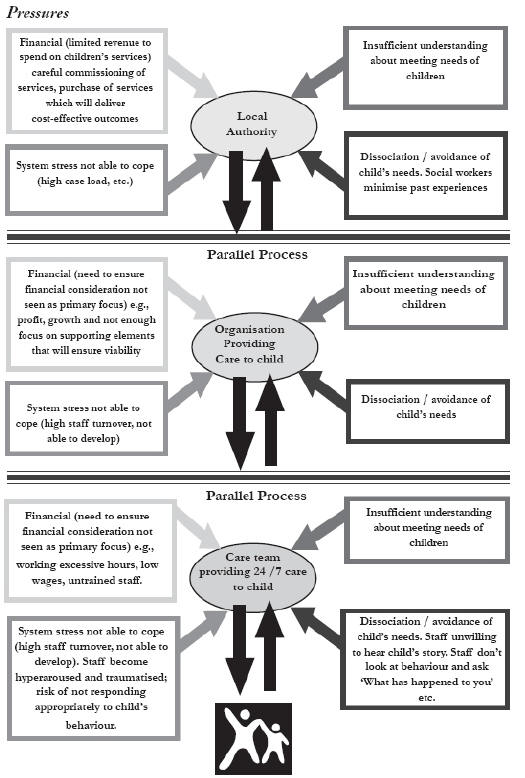
There is a need to do that which is at times is not instinctual and to allow systems, groups and ourselves to be open to reflection and challenge. It is crucial to be able to communicate about issues which have in the past been left unspoken. This is the only way that dysfunctional cultures which can naturally occur in organisations can be changed (Foulkes and Anthony, 1965). This is what is meant by the common saying ‘Hurt people, hurt people’, as ‘loss of words’ is a key hallmark to the start of damaging communication. This can be represented in diagrammatic form: (shown overleaf).
My experience of implementing such approaches in organisations is that it takes a significant emotional shift to encourage open communication among the staff team which means truly saying what is normally left ‘unspoken.’
Another benefit is that this approach challenges what can be called ‘the fallacy of delusional equilibrium’ (Docker-Drysdale, 1991, p. 148). This implies that by keeping things calm and smooth on the surface, any chaos below this need not be recognised or addressed. Breakdown of this false equilibrium at any time often means that suppressed feelings are projected onto any available scapegoat. If such processes go unchallenged and services have not been developed to meet such complex needs, abusive practices can begin to occur within the residential care environment, which can be disguised as an attempt to manage children’s behaviour (Levy and Kahan, 1991).
Specialist therapeutic residential services need to have a range of structures in place to address the needs of their children and the staff groups who work with them. A clear theoretical framework should be in place and implemented through adequate training. This will provide a foundation for the development of the culture and vision of the organisation. Good management is important. I would, however, propose that it is possible to have management without therapy, but not therapy without management. Management in this context includes safety, boundaries and all aspects of the organisational structure. Without these structures, feelings of mistrust, insecurity and anxiety are likely to be the dominant dynamics within the environment. This, of course, can be a parallel in terms of the children’s experiences. The whole environment must be organised and managed in such a way that the therapeutic model can be implemented and that everyone has a clear understanding of tasks, roles and responsibilities.
Currently the dominant focus within service development in Scotland’s ‘therapeutic’ provision has been on the ‘bricks and mortar’ of the homes. Therapeutic is seen in terms of size, for example, the small group care house. However, I suggest that much more needs to be done to ensure the basis for the belief that this is therapeutic in its own right is researched and evidence-based. My belief is that for some children this may, in fact, create a more intense experience which may not necessarily be positive. Issues such as attachment can on the one hand be extremely healing; on the other, if we do not have the necessary knowledge to facilitate healing, it may increase the likelihood of placement breakdown. I advocate therefore that those organisations providing specialist therapeutic residential services in Scotland ensure that they have the structures in place which are required to provide for the needs of most hurt and injured children in our society and help them heal. I have outlined some brief thoughts below to illustrate some areas which I believe will have an impact on all levels in the organisation, with points of action which might be considered:
Pressures and factors which can occur at various levels within society and group functions that can impact on the child’s care within a residential setting
Conclusion
The UN Convention on the Rights of the Child states: ‘Governments should do all they can to promote physical and psychological recovery and the ‘social reintegration’ of children who have been neglected, exploited, tortured or been subject to any form of cruel, inhuman or degrading treatment’ (UNICEF, 2009) .To do so requires that Governments need to ensure that children have access to appropriate services. Specialist therapeutic residential services offer one resource to help meet these needs. As I sit and write this conclusion I would like to emphasis the words of Donald Winnicott (1964):
Now what happens if the home fails the child before he has a framework of his own nature? The popular idea is that, finding himself ‘free’ he proceeds to enjoy himself. This is far from the truth. Finding the framework of life is broken, he no longer feels free. He becomes anxious and begins to look for a framework elsewhere. (Winnicott, 1964, p. 228)
All specialist therapeutic residential services need to demonstrate an ability to meet the psychological and emotional needs of the client group they have been set up to work with. They should also open themselves up to assessment against this by the appropriate regulatory care inspection frameworks. At the moment, standards for therapeutic communities for children are currently being finalised by the Royal College of Psychiatry ‘Community of Communities’ initiative. This may be a good starting point.
We should also pay attention to how the overall system can reflect dysfunction, and be prepared to deal with this. I propose that one way of breaking re-enactment patterns and parallel processes is to focus in on the particular needs of the children coming to stay with the organisation and to develop appropriate structures to meet these. These structures then direct the organisation along with the vision. In the end, this leads to shared governance. If we are able to focus solely on what are the underlying needs of the children in all of our residential child care services in Scotland, I believe we will be able to design key performance indicators which are measurable. This will help us to provide the evidence that we not only provide a good standard of care but also help children heal.
So I will end as I started with a question: ‘Do you seek to be a specialist therapeutic residential care provider for children and young people who have complex needs?’
References
Bion, W. (1977). Group dynamics: A re-view. In M. Klein, P. Heimann and R. Money-Kyrle, (Eds.), New directions in psychoanalysis: The significance of infant conflict in the pattern of adult behaviour. London: Karnac.
Bloom, S. (1997). Creating Sanctuary: Towards the evolution of sane communities. London: Routledge.
Department of Health (2001). Children looked after in England: 2000/2001 (Bulletin 2001/26). London: Department of Health.
Docker-Drysdale, B. (1991). The provision of primary experience: Winnicottian work with children and adolescents. London: Jason Aronson.
Farmer, E. & Pollock, S. (1998). Sexually abused and abusing children in substitute care. Chichester: John Wiley & Sons.
Foulkes, S.H. & Anthony, E.J. (1965). Group psychotherapy: The psychoanalytic approach. London: Penguin Books.
HM Inspectors of Education and the Social Work Services Inspectorate (2001). Learning with care: the education of children looked after away from home by local authorities: A report of an inspection undertaken jointly by HM Inspectors of Schools and the Social Work Services Inspectorate. Edinburgh: Scottish Executive.
HM Inspectors of Education (2006). The journey to excellence. Edinburgh: The Stationery Office.
Jones, M. (1982) The process of change. London: Routledge.
Levy, A. & Kahan, B. (1991). The Pindown experience and the protection of children: The report of the Staffordshire Child Care Inquiry 1990. Staffordshire County Council
Main T.F. (1946). The hospital as a therapeutic institution. Bulletin of the Menninger Clinic, 10, 66-70
McCann, J. B., James, A. & Wilson, S.(1996). Prevalence of psychiatric disorders in young people in the care system. British Medical Journal, 313, 1529-1530.
Meltzer, H., Gatwood, R., & Goodman, R. (2000). Mental health of children and adolescents in Great Britain. London: The Stationery Office.
Perry, B. D. (2003). The cost of caring: Secondary traumatic stress and the impact of working with high-risk children and families. Houston: The Child Trauma Academy.
Perry, B. D. (2005). Maltreatment and the developing child: How early childhood experience shapes child and culture. Inaugural Lecture for The Margaret McCain Lecture Series. Canada: Centre for Children and Families in the Justice System.
Putnam, F. W. (1993). Dissociative disorders in children: Behavioural profiles and problems. Child Abuse and Neglect, 17, 39 45.
Scottish Government (2009). Getting it right for every child: Values and principles.
SWIA, (2006). Extraordinary Lives: Creating a positive future for looked after children and young people in Scotland. Edinburgh: The Stationery Office.
Terr, L. C. (1991). Childhood traumas: An outline and overview. American Journal of Psychiatry, 148(1), 10-20.
UNICEF (2009). The United Nations Convention on the Rights of the Child. Accessed on 20th June, 2009 at http://www.unicef.org/rightsite
Winnicott, D (1964) The child, the family and the outside world. Harmondsworth: Penguin.
From: Scottish Journal of Residential Child Care, Volume 9, Number 1, February/March 2010, pp. 18-27