
































A case study of a children’s therapeutic residential care provider consisting of five homes in England was carried out to consider the feelings and reflections of the managers on children leaving the home. This is an unexplored perspective/ subject which considers the significant and emotional transition of leaving care. The reflections in this case study can be used to improve practice for social care providers and give insights into a niche area of work. To explore this topic, a focus group was carried out with four residential home managers and two psychotherapists who work at the same care provider. It was found that the subject of leavers was not much reflected on and it was agreed that it needed to be to improve practice, as well as processing certain unconscious feelings around the child. Failure was a prominent feeling potentially derived from the pressure of ending cycles of failure for the children as well as unconscious projections held by the managers. There were also found to be certain issues around terminology, such as 'planned' and 'unplanned', used in this area of work which holds particular connotations. Lastly, it was found that relationships with local authorities were significant for ensuring healthy transitions.
Keywords
Residential care, care leavers, managers, reflections, children’s homes, England
Introduction and rationale
Leaving a residential care home is an inevitable part of every child’s placement and is argued to be the most emotional part of a placement for the child and those working with them (Tomlinson, Gonzales & Barton, 2012). This can generate feelings of separation and loss, requiring time and space for reflection on each leaver, their placement, and their transition, to reduce trauma for everyone involved (Black, Brearley, Gutridge, & Roberts, 2013; Tomlinson et al., 2012). Previous research has explored placements, breakdowns, and the impact of leaving care (Brown & Bednar, 2006; CELCIS, 2018; Egelund & Vitus, 2009; Harkin & Houston, 2016; Hek & Aiers, 2010; Khoo & Skoog, 2013; NICE, n.d; Rock, Michelson, Thomson, & Day 2013; Sallnäs, Vinnerljung, & Kyhle Westermark, 2004; Tomlinson, 2005; Tomlinson et al. 2012). However, there seems to be a gap around care home managers and their feelings and reflections on the subject of leavers both as a group and on individual cases. Often research may focus on the child’s key worker, as they are seen as the ‘main carer’, but not on care home managers despite them being just as emotionally invested (Black et al., 2013).
This case study set out to explore the feelings and reflections made by a group of care home managers on leavers. Using a psychoanalytic lens, we wanted to analyse if and how the managers are reflective and emotionally affected by leavers and also how this is changed based on the nature of the ending and the context. We believe that managers, and the home by extension, often do not have the space to reflect on children leaving. This is backed up by the lack of literature on the subject when arguably it is a significant matter which should have more light shed on it.
We would hope that the reflections taken will allow the managers to understand, accept and develop their awareness of both: the feelings that may be left behind by the children, and their approaches to leavers to improve care in future
What the children bring with them and what they leave behind
The levels of trauma experienced by children in care mean that they generally have highly fragmented inner worlds, consequently, the fragmented inner world of the child is projected onto the adults (Dockar-Drysdale, 1993). Adult-child relationships are reciprocal, and though the adult influences the child, so does the child influence and impact the adult (Fahlberg, 1994). This is significant when thinking about how the children project feelings that are difficult to handle, certain ‘bad parts’ of themselves, such as feelings of anger or failure which the staff then internalise and manage (Ogden, 1982; Stokoe, 2003). Projection is an unconscious process as part of a defence mechanism, where one's own unpleasant, unmanageable or unacceptable feelings, impulses or stressors are externalised onto another person (Ogden, 1983). Due to their past, children may arrive carrying failure, which can get left with staff when the placement ends (Chipungo & Everett, 1994). Any ending at any point is complex as there will be elements of projections which have not been fully processed in some groups.
Much of the emotion that is left behind in the staff will have emerged from the child’s inner pain and become projections from the child’s fragmented mind.
When thinking about the effect this has on the adults working with the child, we consider the idea of countertransference. This means the adult is then influenced and affected by the child’s feelings and understanding about the world (Youell, 2006). These views may be difficult or upsetting for adults to take on.
Additionally, the complexities of these unconscious processes lend themselves to being interrelated; for example, splitting could be linked to projection and projection may be overlapped with transference or countertransference. To prevent this affecting the other children in the home, or potentially new children coming in, the adults in this care provider are offered regular reflective spaces e.g. groups and supervision. To process and hold all these emotions, there is a’ holding environment’ whereby a person’s physical and emotional wellbeing are held safely by others (Winnicott, 1965). This offers layers of emotional containment which ensures that the children and staff are taken care of and held. Due to the intense trauma faced by the children, this holding environment is held within a therapeutic framework and forms organisational layers, of which the manager is the head and responsible for in the home. However, due to the emotional outputs of both the children and staff members, the manager is liable to receive many projections and transferences (Rose, 1990). They therefore will have the challenge of managing and processing all the parallel unconscious processes within the home while also looking after the smooth running of their community (Bullock, 2008; Hicks, Gibbs, Weatherly, & Byford, 2007; Menzies- Lyth, 1988; Rose, 1990).
While receiving so many unconscious emotions, the managers must also be aware of changes in dynamics and stay in tune and emotionally connected to the children and staff in the home (Burton, 1998). At the time of placement ending, the individual child would be experiencing an abundance of ranging emotions and heightened anxiety at moving on (Tomlinson, 2005). There would also be mixed feelings of loss and happiness by the staff and children's group in response to a member of the care home family leaving (Tomlinson et al., 2012). This is why we argue that it is significant for the managers to reflect deeply on every leaver as they have built these emotional connections and become invested in their development. Through reflection they may also become more aware and responsive to the atmosphere, current residents, and staff, and therefore can better maintain the therapeutic ecology (Burton, 1998).
However, it is established that there is an uneasiness around the discussion of how children’s therapy comes to an end (Lanyado, 1999). Nevertheless, it is argued that it is essential to discuss this area of endings as, to be truly helpful to the child, this must be thought about; it is a vital experience in the therapeutic process (Lanyado, 1999). It may be that the managers may find it difficult to reflect on the leavers, especially with cases that seemed 'unplanned' (in whichever definition they deemed suitable for the case). As mentioned, some unconscious processes will not reach a natural resolution; we contend that many of the most potent experiences for the managers can be related to those times when a process has not reached such a conclusion.
Defining the terminology of placement endings
Historically, there is certain terminology used in this area such as: ‘placement breakdown’, ‘disruption’, ‘instability’ and ‘unplanned ending’ (Harkin & Houston, 2016). However, one could argue that it is difficult to objectively assign one of these terms to a placement ending. For example, past research on this subject defined the term ‘placement breakdown’ based on just the length of placement or age of the child (Sallnäs et al., 2004). Other definitions describe a ‘placement breakdown’ as ‘an unanticipated and untimely placement ending that is not included in the young person’s care plan’ (Berridge & Cleaver, 1987, p. 6). It is more recently argued that the definition should incorporate and consider the relationships involved between the care provider, the local authority and the child to define the nature of a placement ending (Sallnäs et al., 2004).
Furthermore, a Swedish study of foster carers found that rather than being an individual event, a placement breakdown was a complex process which was shaped by the individuals and context involved (Khoo & Skoog, 2013). It therefore seems vital to consider and examine each leaving event independently rather than assigning overarching definitions or terminology which do not allow for individuality and context.
We can see the inconsistency in how a ‘breakdown’, or an ‘unplanned move’ are defined and additionally we wonder what purpose it serves to label placement endings in such a way. This type of terminology inevitably produces certain ‘negative’ or ‘positive’ connotations which may not be very reflective of the situation. A move, though unsettling, does not always present a negative transition; it can be healthy based on the context (NICE, n.d).
Context
The organisation on which this case study is based is a therapeutic residential care provider made up of five homes in England at the time of writing. The homes are made up of four to 10 children, with age ranges of six to 12 in two homes and 13-16 in the other three. The primary objective of the care provider is to heal trauma, help children and young people build healthy relationships, and to hold and contain them in a way they have not been before within a nurturing family like environment.
The organisation is run via the Integrated Systemic Therapy (IST) Model. This applies psychodynamic/ psychoanalytic concepts to understand the unconscious processes affecting a child’s wellbeing and functioning, while also therapeutically containing all the structural layers around each child including all staff and managers in their day-to-day work. IST is rooted in the therapeutic community and the psychoanalytic movement though both the planned environment or milieu therapy and systemic (family/ group) thinking via dynamic group spaces.
Method
In keeping with the IST methodology, which uses group dynamics and group work as a therapeutic intervention, it seemed appropriate to conduct this small- scale qualitative case study through a focus group. This method allows a natural interaction and journey through themes with the ability to experience the consensus and difference within the group (Bryman, 2008; Morgan, 1998).
Additionally, as this is a sensitive topic, and potentially quite provocative, a group may be more supportive rather than individual interviews as the participants would have alike experiences (Barbour, 2008).
The focus group comprised four of the children’s homes managers and two psychotherapists who work closely with the managers and other staff and are integrated with and knowledgeable about the work. The psychotherapists were added to the group to help mediate the sensitivity of the topic, facilitate conversation and to offer insight and reflection on the leavers, situations and the manager’s feelings.
The focus group was somewhat 'unstructured' in that there were no set questions or guides. The aim was to see what the natural flow of the narrative or reflection on leavers would be. The discussion was guided around statistics on the children that left their placement in the last two years and the nature of their leaving. The focus group was audio-recorded and transcribed.
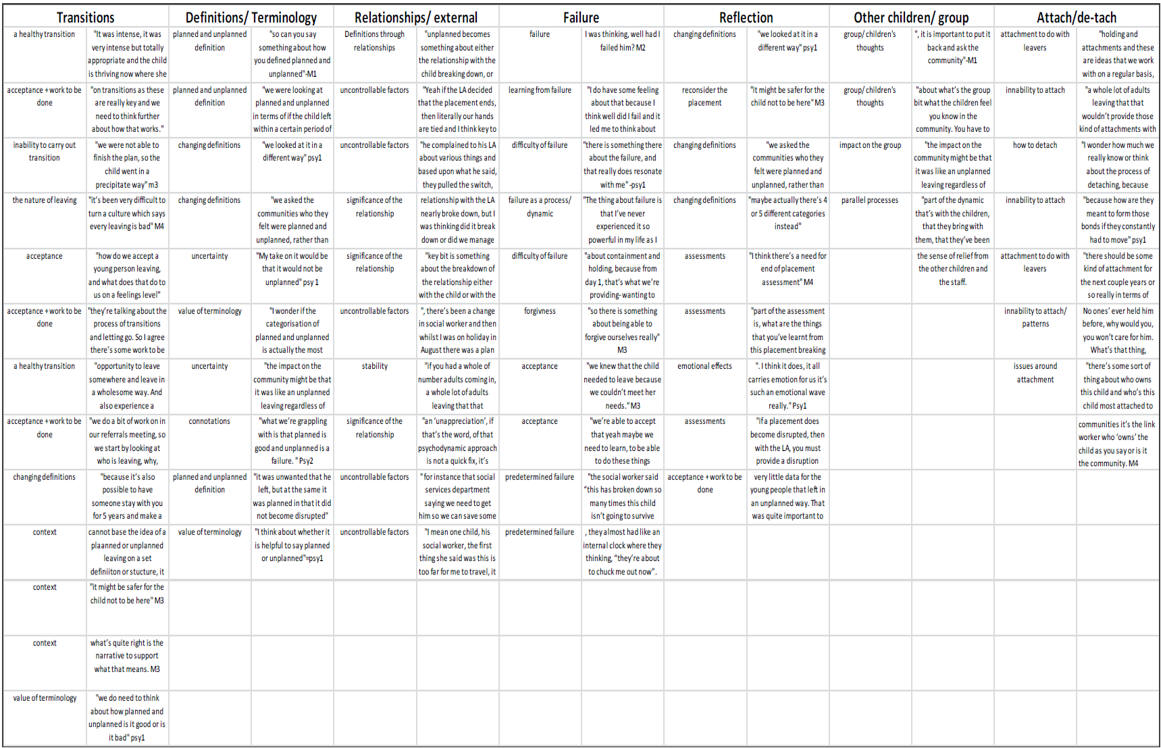
To analyse underlying themes and feelings, thematic analysis guided by Braun and Clarke’s (2006) process, was used to examine the data which seemed appropriate at this exploratory stage (please see Table 1 for reference).
Ethical approval was granted by the organisation's ethics committee, and consent was obtained by all the participants.
Results
From the thematic analysis, certain themes and concepts emerged which flowed throughout the conversation.
Figure 1: Thematic analysis diagram
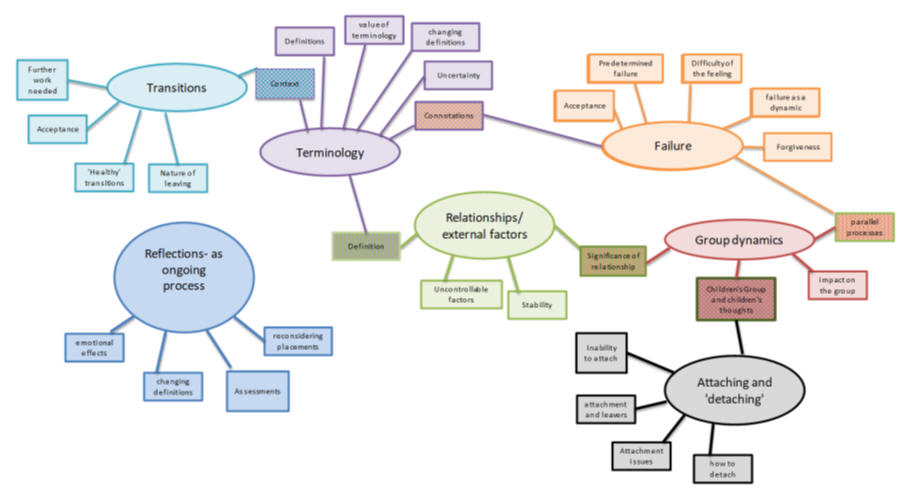
Transitions
The discussion began with transitions and the process of a child leaving the home and how this is managed. However, instantly there seemed to be some unease or space for excuses to be made in not having thought about leavers enough, as well as acknowledgement that more needs to be done:
M1: … the process of transitions and letting go. So I agree there’s some work to be done.
M3: …we do a little bit of work … looking at who is leaving, why, where, when …
PSY1: … need to think further about how that works …
As hypothesised, it seemed that transitions of children leaving care, and these reflections, were not focused on enough and that more consideration and processes need to be put in place to consider the leavers. In addition to this, the idea of quick or unprocessed data around leavers gave the sense of not holding the child in mind:
M3: … we were not able to finish the plan, so the child went in a precipitate way… it said something about systems and processes that weren’t in place, or was it the fact that we could not hold this child in mind?
This seemed difficult, as though the child was let down. However, it was discussed that if the time and space can be given for their transition, it can be very healthy and positive. This included leaving ‘ceremonies’ of a sort which can process ‘goodbyes’, creating a healthier separation for the leaver and the rest of the home:
M3: … experience a separation that is healthy…get her and the children to put together a programme of her leaving. So we’ve got a calendar of eight weeks… and how the children can work with her, and when her leaving date is…
Terminology
A significant area of debate was around the terminology of the nature of leavers in terms of ‘planned’ and ‘unplanned’. These are quite generic terms for this area but hold inconsistency and uncertainty as can be seen from the quotes below:
M1: Can you say something about how you defined planned and unplanned?
PSY1: … looking at planned and unplanned in terms of if the child left within a certain period of time, but then we thought…was that an appropriate place for the child to move onto?
M1: … it was unwanted that he left, but at the same it was planned in that it did not become disrupted.
PSY2: … It probably feels like unplanned, meaning quite muddily.
As can be seen from the above quotes there was some confusion and contention when it came to the words ‘planned and ‘unplanned’. Additionally, the value of such terminology was disputed due to the connotations and the potential culture it can form, which ideally needs shifting:
M3: We used to treat that as a tragedy. So, we’re trying to rebrand it to say let’s look at why this person is leaving…very difficult to turn a culture which says every leaving is bad.
PSY2: I wonder if the categorisation of planned and unplanned is actually the most helpful thing…what we’re grappling with is that planned is ‘good’ and unplanned is a ‘failure’.
When considering terminology, one of the main outcomes was that context of each child/ case must be considered to understand the nature of a leaving rather than label it based on set rules:
M3: What’s quite right is the narrative to support what that means.
PSY2: … it’s also possible to have someone stay with you for 5 years and make a complete hash of the ending by contrast.
The discussion presented the importance of reflecting contextually by individual case to understand leavers.
Relationships and external factors
The nature of a leaving seemed closely linked with how relationships were managed, particularly with the local authority and social workers:
M1: … unplanned becomes something about either the relationship with the child breaking down, or maybe even the relationship with the local authority breaking down.
M2: …there’s been a change in social worker and then whilst I was on holiday in August there was a plan to pull him.
M3: I mean one child, his social worker, the first thing she said was this is too far for me to travel… So, the first time she came to us she was like, ‘I need to get a taxi from the train station, who’s going to pay then?’ so in the end I said we’re going to pay because we cannot have something like £27 become the showstopper for the child… driver is the social worker’s needs, not the child’s.
The managers seemed to feel helpless in these situations and frustrated at both the external factors and the lack of appreciation of the IST methodology by which they run; this emphasises relationships and long-term therapeutic interventions:
M2: … an ‘unappreciation’, if that’s the word… psychodynamic approach is not a quick fix, it’s about relationships.
Regardless of such issues, there appeared to be a consensus on the parallel between keeping a healthy relationship with external bodies and ensuring a healthy placement and transition for the child. M1 explained later that even if a child must move on for whatever reason, a healthy transition can be ensured by maintaining a good relationship:
… we managed to keep something of the relationship with the local authority kind of going so that he could leave in a planned way.
Failure
Regardless of the reason for ending the placement, the feeling of failure was heavy in the room upon reflection of the leavers. It was a concept that came up multiple times and the insecurity around it was very present and painful:
M2: … I was thinking, well had I failed him?
The managers expressed failing via their main task of providing stability and containment:
M4: … about containment and holding, because from day one, that’s what we’re providing- wanting to provide stability. So, if a child is only with us three months, then leaves, that’s not providing stability for the child.
There were descriptions of unconscious processes around failure in the form of projections, parallel processes and self-fulfilling prophecies:
PSY1: … they bring with them, that they’ve been failed. Then it gets into the adults … it’s a parallel process.
PSY1: … the social worker said, ‘this has broken down so many times this child isn’t going to survive more than a couple months here’. So already when you’re thinking about the failure it’s kind of like the social worker has that idea, suggesting that the child is going to fail.
M3: … they almost had like an internal clock where they’re thinking, ‘they’re about to chuck me out now’.
It felt as though failure was almost ingrained in the discussion about the leavers due to being constantly disappointed by the adults and the system around them. The managers accepted failings and the need to reflect on them. However, they also discussed the importance of acceptance to learn and move forward:
M2: I think well did I fail, and it led me to think about how passionate I am about the current placements and what we’re doing with the local authority and that.
Additionally, it was to be accepted that sometimes the placement is not fitting or healthy for a child and that the appropriate step is for them to move on to a more successful or fulfilling placement:
M3: … we knew that the child needed to leave because we couldn’t meet her needs… it might be safer for the child not to be here…so there is something about being able to forgive ourselves really …it was very intense but totally appropriate [moving on from the placement] and the child is thriving now where she is.
Assessments
Many of the above reflections led to and focused on formal assessments conducted at different stages and the need to review them:
M4: … part of the assessment is what are the things that you’ve learnt from this placement breaking down…I think there’s a need for end of placement assessment.
M1: If a placement does become disrupted, then with the local authority, you must provide a disruption report. But it’s a much better idea to have an end of placement report for all children. It might also help to bring these things together and define planned and unplanned.
Conducting an end of placement review seemed an agreeable plan to help evaluate placement endings regardless of the nature of leaving. This reflection on leavers through a formal assessment would be quite supportive in both guiding transitions and also learning from experiences of each placement. It would also provide a formal and allocated space for reflection that hasn’t been present but seems imperative.
The other children in the home
The managers also considered the complexity and impact of leavers on the other children in the home and the importance of considering the change in the group dynamics.
M1: It is important to put it back and ask the community … the group bit, what the children feel you know in the community. You have to take all of that into consideration.
As we can imagine, there may be feelings of separation and loss at a child leaving the care home family. However, for several reasons a placement may not be functioning and the ending of it can feel a healthy release for the rest of the group, as M3 describes a case:
M3: My recollection was the sense of relief from the other children and the staff [after a child had left]. Some of the kids still talk to her.
Attaching and detaching
Attachments with leavers and the complications around them were debated. Such a care provider aims to help form healthy attachments with the children, creating a very close bond similar to parent and child. This, however, causes some problematic dynamics around 'ownership' (not in an objective sense to own them but a sense of family belonging):
PSY2: … there’s some sort of thing about who owns this child and who’s this child most attached to and so on.
M4: I think from the communities it’s the link worker who ‘owns’ the child as you say or is it the community?
It was then argued that a wider problem occurs on leaving with the notion ‘detachment’:
PSY2: I wonder how much we really know or think about the process of detaching, because that’s what we’re talking about here … want to provide stability… but maybe one of the things we’re actually not so good at is about helping children detach from us, even in a planned way.
However, this felt a difficult and slightly unfair concept to consider for both the children and the staff:
M2: … there should be some kind of attachment for the next couple years or so really in terms of making sure there’s links and inviting them back to the home every year and so.
This process of a gradual ‘detachment’ appeared to be quite agreeable and further consideration on the process was planned for future discussion.
Discussion
Initially mentioning leavers seemed to elicit feelings of unease and defensiveness, which aligns with what Lanyado (1999) stated with regard to this topic. The group agreed and accepted there needed to be more reflective practice, improving formal assessments and general focus around leavers.
The work involves forming and developing healthy attachments, and when this is successful, it is difficult to say goodbye and ‘detach’ in a positive manner, which is why the leaving transition is significant to think about. Tomlinson (2012) argues this transition can celebrate the child’s therapeutic journey which does not have to be ‘sad’ or ‘negative’ as the move may be a healthy, natural, or appropriate next step for the child and the home. The managers also mentioned the negative culture around leavers which may need shifting, as M3 mentions: ‘we used to treat that as a tragedy. So, we’re trying to rebrand it to say let’s look at why this person is leaving…very difficult to turn a culture which says every leaving is bad’. The idea around creating a type of meaningful ‘goodbye ceremony’ to show the significance of the relationship to both the leaver and the rest of the children in the home seems an interesting idea which could be quite healthy from a therapeutic standpoint when considering how important endings are (Lanyado, 1999).
The discussion around definitions and terminology was significant due to the lack of consistency and differing connotations associated with certain words. Within this work, words such as 'unplanned', 'breakdown' or 'premature' are used regularly, however, the connotations around these words are not reflected upon much. As mentioned in the group, initially the data was categorised based on definitions similar to what Sallnäs et al. (2004) found around the length of placement. However, upon further reflection and consultation, it was discussed that each situation should be considered independently and in context. This would allow increased focus and attention, improving care, and transitions going forward. The group also debated whether using such terms are even helpful to begin with due to the connotations associated. Labelling a child's leaving as 'unplanned' or 'planned' can induce an idea of either success or failure which may not be justified, and such language can be damaging.
The experience of children leaving care can evoke intense emotions, and the difficulty was magnified through the belief of not holding or containing the child as planned or promised. This produced powerful feelings of failure in the managers who felt that they had let that child down. As Chipungu and Everett (1994) argue, a child leaving care often results in their carer experiencing loss or failure. In the group, the managers reflected on cases where they felt they could have done more, especially for these children who have been consistently let down and disappointed.
In their parental/ responsible role, the managers may take it upon themselves to feel the pain of failure. This idea of the children being failed so tragically in the past by those who should have been reliable seems to resound. The managers must then be so anxious about not failing the children that when a placement ends in an abrupt way, the feeling resonates so much more. Additionally, there may be certain parallel processes involved whereby the children in the service have constantly faced and experienced failure in different forms and project these feelings onto the adults around them. As Rose (1990) describes, the managers receive projections from the children and will need to manage such parallel processes.
However, regardless of a ‘successful’/ ‘planned’ move or an ‘unplanned’/ ‘abrupt’ move, the transitions should ideally be managed or orientated so a child can leave in such a way where they are not carrying the feeling of failure with them, but feeling they are moving in a healthy appropriate way.
As mentioned in the group, often circumstance is out of their control and the local authority will need to make a final decision, which is based on several varying factors. Understandably, practical issues around time and cost will of course affect the logistics around a placement. Furthermore, we must also consider the various factors and contexts that play a part in the decisions and reflections made by the managers such as political agendas, statutory compliance, financial considerations and child welfare. There is an added pressure to an already difficult balance between emotional and practical management considerations. This understanding, however, does not stop us feeling disappointed in a system where the child’s needs and wellbeing are not put first. When the group were discussing these issues around external factors affecting the placements and the therapeutic work, their anger, frustration and disappointment were tangible. One could sense their years of experience in dealing with such problems that, ultimately, they have no control over.
Unfortunately, this means the therapeutic work comes to a close, but also based on how abrupt the ending is, a healthy transition cannot take place. Interestingly it was stated that the relationship which may or may not be maintained with the local authority impacts on the therapeutic work and the nature of the child leaving. This is why the relationship with the social workers and the local authority is highly significant as they need to feel the child is well looked after and the placement and staff are worth the time and costs involved. It seems that keeping good relationships are key to supporting the child's placement and smooth transition.
In thinking about relationships, it was vital to consider the impact on the other children and the effects a leaver has on them, and subsequently the effect on the dynamics of the group. The managers are responsible for the many layers of containment in the group (Bullock, 2008; Hicks et al., 2007; Menzies-Lyth, 1988). They must always be in tune with the needs of the other children and maintain the therapeutic ecology (Burton, 1998). This may mean that though there is a sense of loss at a child leaving, it may at times be more beneficial to the leaver and the other children depending on the relationships or dynamics they had. This is also an important aspect the managers have to reflect on with every leaver.
Conclusion
This case study has provided an insight into the thoughts, processes and feelings of children’s home managers on children moving on from those care homes, and what emotions may be held by the managers when a child leaves home. From both the literature and the focus group findings, it was evident that this is not an area that has been explored- though arguably it should be. The managers already consider, deliberate and contain many areas and layers of their work within the therapeutic environment; however, they are unable to think about leavers in much detail.
It is highly significant within the care milieu to gain these perspectives of managers as they can implement vital change from their position, resulting in a culture shift. This shift may focus attention on leavers and transitions to improve children and young people's experiences of the care system as well as the emotional containment of those working with them.
We can hypothesise a few reasons why space may not be provided for reflection on leavers. This may be due to factors around: the amount of time, lack of structured or formal assessment, and emotional difficulty in thinking about leavers. It was established however, that it is vital to make space for this reflection for the benefit of both the child leaving and the therapeutic environment in the home. This was found through the various aspects discussed above such as processing unconscious feelings, understanding the therapeutic environment they manage, developing and sustaining relationships, and assessment techniques. It was also established that it would be better to reflect on each child individually within the context to contemplate the nature of the ending, how it could have been improved, and what can be learned from it to improve care going forward.
We are aware that this is a very niche small-scale study of only one group in one organisation. Though it is appropriate for this initial exploratory study, it is also the most significant limitation of this study as it would not give us a generalisable or representative picture of the subject. However, it has been able to give us the initial steps towards further exploring this area of study by giving us a small window of insight. The next steps would be to include more children's homes managers from other organisations to cross-reference themes, feelings and processes. Additionally, the topic of managing transitions could be further examined: this could further inform practice on transitions and leavers to improve processes within the care system.
Table 1: Thematic Analysis
References
Barbour, R. (2008). Doing focus groups. London: Sage.
Berridge, D., & Cleaver, H. (1987). Foster home breakdown. London: Blackwell.
Black, J., Brearley, P., Gutridge, P., & Roberts, G. (Eds.). (2013). Leaving residential care. London: Routledge.
Braun, V., & Clarke, V. (2006). Using thematic analysis in psychology. Qualitative research in psychology, 3(2), 77-101. doi: 10.1191/1478088706qp063oa
Brown, J. D., & Bednar, L. M. (2006). Foster parent perceptions of placement breakdown. Children and Youth Services Review, 28(12), 1497-1511. doi: 10.1016/j.childyouth.2006.03.004
Bryman, A. (2008). Social research methods. Oxford: Oxford University Press.
Bullock, R. (2008). Leadership, structure and culture in residential child care. In A. Kendrick (Ed.), Residential child care: Prospects and challenges (pp. 226- 238). London: Jessica Kingsley Publishers.
Burton, J. (1998). Managing residential care. London: Routledge.
CELCIS (2018). ‘n and beyond the care setting: Relationships between young people and care workers: A literature review. https://www.celcis.org/knowledge-bank/search-bank/and-beyond-care-setting-relationships-between-young- people-and-care-workers-literature-review/
Chipungu, S. S., & Everett, J. E. (1994). The power of information: Exchange patterns between African-American foster parents and child welfare workers. Journal of Multicultural Social Work, 3(3), 17−33. doi: 10.1300/J285v03n03_02
Dockar-Drysdale, B. (1993). Therapy and consultation in child care. London: Free Association Books.
Egelund, T. & Vitus, K. (2008). Breakdown of care: The case of Danish teenage placements. International Journal of Social Welfare, 18(1), 45-56. doi: 10.1111/j.1468-2397.2008.00564.x
Fahlberg, V. (1994). A Child’s journey through placement. London. BAAF
Harkin, C. & Houston, S. (2016). Reviewing the literature on the breakdown of foster care placements for young people: complexity and the social work task. Child Care in Practice, 22(2), 98-112. doi: 10.1080/13575279.2015.1102124
Hek, R. & Aiers, A. (2010). Promoting best outcomes for children and providing best support for carers: A review of selected literature for Foster Care Associates. Birmingham: International Centre for Research and Innovation in Fostering. https://research.birmingham.ac.uk/portal/en/persons/rachel- hek(00d023b9-db84-490b-a6f7-9eab3e1e7f71).html
Hicks, L., Gibbs, I., Weatherly, H., & Byford. S. (2007). Managing children's homes developing effective leadership in small organisations. London: Jessica Kingsley Publishers.
Khoo, E., & Skoog, V. (2013). The road to placement breakdown: Foster parents' experiences of the events surrounding the unexpected ending of a child's placement in their care. Qualitative Social Work: Research and Practice, 13(2), 255-269. doi: 10.1177/1473325012474017
Lanyado, M. (1999). Holding and letting go: Some thoughts about the process of ending therapy. Journal of Child Psychotherapy, 25(3), 357-378. doi: 10.1080/00754179908260301
Menzies-Lyth, I. (1988). Containing anxiety in institutions. London. Free Association.
Morgan, D. L. (1998). The focus group guide book. Thousand Oaks: Sage Publications.
NICE (n.d). Looked-after children and young people. https://www.nice.org.uk/about/nice-communities/social-care/tailored- resources/lacyp
Ogden, T. (1982). Projective identification and psychotherapeutic technique. Lanham, Maryland: Rowman and Littlefield Publishers.
Ogden, T. H. (1983). The concept of internal object relations. International Journal of Psycho-Analysis, 64, 227-241.
Rock, S., Michelson, D., Thomson, S., & Day, C. (2013). Understanding Foster Placement Instability for Looked After Children: A Systematic Review and Narrative Synthesis of Quantitative and Qualitative Evidence. British Journal of Social Work, 45(1), 177-203. doi: 10.1093/bjsw/bct084
Rose, M. (1990). Healing hurt minds: The Peper Harrow experience. London. Tavistock/Routledge.
Sallnäs, M., Vinnerljung, B., & Kyhle Westermark, P. (2004). Breakdown of teenage placements in Swedish foster and residential care. Child & Family Social Work, 9(2), 141-152. doi: 10.1111/j.1365-2206.2004.00309.x
Stokoe, P (2003). Group thinking. In A. Ward, (Ed.) Therapeutic communities for children and young people. London: Jessica Kingsley Publishers.
Tomlinson, P. (2005). The Capacity to think: Why it is important and what makes it difficult in work with traumatized children. Therapeutic Communities, 26(1), 41-53.
Tomlinson, P., Gonzalez, R., & Barton, S. (2012). Therapeutic residential care for children and young people: An attachment and trauma-informed model for practice. London: Jessica Kingsley Publishers.
Winnicott, D. W. (1965). The maturational processes and the facilitating environment. New York: Karnac Books Ltd.
Youell, B. (2006). The learning relationship: Psychoanalytic thinking in education. London: Karnac Books Ltd.
From: Scottish Journal of Residential Child Care, Vol20, No.1


