































This paper is based on work undertaken on behalf of the Scottish Development Centre for mental Health and it explores key challenges in addressing the mental health needs of children and young people who are looked after away from home. It considers some models of working that show promise in building bridges between activities to promote good mental health for all such children, as well as highlighting activities that focus on assessment, care and treatment for those who require such intervention.
Mental health of children and young people
A considerable body of recent research highlights the importance of childhood experiences in laying the foundations not only for individual mental health and wellbeing later in life, but also for the development of trusting social and community relations and for creativity and productivity (Foresight project, 2009; Layard & Dunn, 2009). Influences on children’s mental health and wellbeing at the level of the individual child, the family and the wider community are summarised in the tables 1 and 2.
Children and young people who are looked after
The influences that affect the mental health and wellbeing of children who are looked after are similar to those that affect all children. However, the circumstances that lead to a child becoming looked after (loss, bereavement, trauma, lack of continuity in caring relationships, or the accumulation of stressors) combined with the experience of being looked after tend to have a considerable impact on the mental health and wellbeing of a child or young person. It is not surprising that young people who are looked after highlight the importance of control and choice when seeking and receiving support and of continuity in relationships with care-givers and with friends (Stanley, 2007). Children who are looked after are more likely to experience poor mental health and develop mental health problems, compared with the general population of children (Meltzer et al., 2004). Mental health problems are just as prevalent among those who are looked after and living at home with their families as among those who are in foster care or residential care.
| Table 1: Risk factors for mental health and wellbeing | ||
| Child | Family | Community |
| Learning difficulties | Parental conflict | Socio-economic disadvantage |
| Communication difficulties | Family breakdown | Homelessness |
| Developmental delay | Inconsistent discipline | Disaster |
| Genetic influences | Rejecting relationships | Discrimination |
| Difficult temperament | Inability to adapt to child’s changing needs | Other significant life events |
| Physical illness | Parental mental illness | |
| Academic “failure” | Physical, sexual or emotional abuse | |
| Low self-esteem | Death or loss of close relationship | |
| Table 2: Protective factors for mental health and well-being | ||
| Child | Family | Community |
| Secure early relationships | At least one good parentchild relationship | Wider social network |
| Positive attitude | Affection | Good housing |
| Problem-solving skills | Clear, consistent discipline | High standard of living |
| Communication skills | Support for education | Positive school ethos |
| “Easy” temperament | Supportive long-term relationship | Positive peer relationships |
| Capacity to reflect and learn from experience | Range of opportunities for pro-social activities | |
| Healthy living, eg. diet, activity levels | Opportunity to be heard/ participate/ exercise control | |
| Safe environments | ||
Poor mental health in children who are looked after tends to be manifested in complex ways which can differ greatly from child to child and which may not constitute a readily definable set of symptoms. For this group of children, the appropriate starting point may not centre on establishing a diagnosis using categorical models of disorder but may emerge from concerns elicited by the child’s behaviour. Experienced practitioners suggest that it is more useful with this population to work with concepts of change, trauma, resilience, loss and attachment and to take an ecological view of the presenting behaviour that situates that behaviour within the child’s current and past experiences. These are significant considerations in relation to the types of service models and interventions that are likely to be useful in addressing mental health in the context of the care system.
Where children require treatment and care, experience suggests that therapeutic work with the looked-after population is not adequately delivered through ‘standard’ arrangements for specialist child and adolescent mental health provision. This is a question partly of how services are organised and resources allocated, waiting times from referral to assessment, and services being provided in clinical settings that are perceived as stigmatising by children and young people (Barbour et al., 2006). It also stems more fundamentally from the different conceptual frameworks on which care services and treatment services are constructed (McCollam & Woodhouse, 2007).
Policy context
The mental health of children and young people: A framework for promotion, prevention and care (FPPC) (Scottish Executive, 2004) makes bold statements about the importance of the mental health and wellbeing of all children and young people as a shared responsibility across sectors. The FPPC acknowledges that some groups of children and young people are at heightened risk of poor mental health and those who are or have been looked after are among these. Specific action is required to promote the mental health of this group, to prevent the development of problems and address the needs of those in distress through:
The Scottish Needs Assessment Programme (SNAP) working group surveyed the experiences of a wide range of professionals working with children, young people and families and identified some key concerns among the residential care workforce. These included the high perceived need for training on mental health, better access to advice and support to enable them to care appropriately for children and young people in distress and the need for specialist services to be more flexible to provide ‘outreach’ support to fit the context in which the child is being supported (Barbour et al., 2006).
The Extraordinary Lives review of care for children who are looked after drew attention to the health inequalities experienced by this group of children and young people and recognised that achieving and maintaining good health is a priority for them and their carers. To this end, the review recommends that details about a child’s health are fully recorded and the information passed on quickly to new carers if the child moves placement. Care providers should be aware of the increased likelihood that some children and young people who are looked after away from home may develop mental health problems, and know how to gain access to appropriate help at an early stage. The review highlights the importance of coordinating local services to help looked-after children and young people get the best possible health care (Social Work Inspection Agency, 2006).
The national review of educational and other outcomes (Scottish Executive, 2007) and the Ministerial task force on health inequalities in Scotland (Scottish Government, 2008) recommend that all NHS Boards should assess the physical, emotional and mental health needs of children who are looked after and act on that assessment with their local partners, to ensure that health services are more accessible to this group, especially when they are moving on from care to independence. Each local NHS Board is expected by 2015 to offer a mental health assessment to every child or young person who is looked after.
Service and practice development
Achieving improved outcomes
It is not possible to define ‘good quality’ foster care or residential care in terms of specific aspects of an individual service in isolation from the wider care system, in view of the complex social and familial factors that shape the course of a child’s life and the significance of wider cultural expectations and influences. From a mental health perspective ‘everything counts’: structures, relationships, the physical environment, interventions, access to specialist resources and access to family and community supports (Clough et al., 2006). The Scottish Development Centre for Mental Health (SDC) described models and approaches to support children’s mental health (McCollam et al., 2008b). In this work, the following factors emerged as major issues that care systems need to address to be able to meet the full range of mental health needs of children who are looked after:
The views of young people who have been looked after corroborate these points (Happer et al., 2006; Stanley, 2007).
Developing a mental health resource for children and young people who are looked after away from home
There are inherent tensions between the need to cope with and respond to the immediate mental health needs of the current looked-after population and the need to take a longer term strategic focus on achieving potentially more lasting solutions. The latter requires action to support families, facilitate early intervention, prevent family or placement breakdown, and enable children to receive care within their local area, as far as possible. Taking steps actively to address mental health needs can make a significant contribution towards achieving the longer term health, social and economic outcomes desired for this group.
Whilst the long-term vision may be to ‘mainstream’ responsibility for the mental health of looked-after children as a core component of the work of child and family services, for the foreseeable future the need remains for transitional investment in service models such as those developed in some parts of Scotland. A common feature of these services is that they operate at several levels and encompass direct work with some children and young people, as well as training and consultation with carers. These services share common goals to:
Some mental health projects working with children and young people who are looked after away from home have focused specifically on providing direct support to children and young people, for example the LEAP service in Ayrshire that offered counselling support (Milligan, 2004). Most, however, combine direct work with training and consultation functions, in differing proportions. There is no blueprint to determine the ‘best’ way to configure a mental health resource or the optimum scale or scope of such a resource. The primary aims of a service and the allocation of roles and responsibilities vary from one local context to another depending on local service patterns and how skills and resources are deployed.
Building capacity and capability to address mental health in care settings
Training programmes and case consultation offered by the mental health services help generate a shared understanding of mental health and how that can be operationalised in practice across the care system. This approach builds confidence and competence in addressing needs within care settings from a perspective that recognises the importance of promotion and prevention and does not only respond to presenting problems and crises. In addition, it provides a means for care staff to gain a deeper understanding of the factors that contribute to a child’s behaviour and of the impact of the care environment in promoting mental health and wellbeing.
The mental health services that work in this way are seeking to embed mental health into the way care services operate day-to-day so that this becomes sustainable:
Notwithstanding the difficulties involved in evaluating the impact of interventions that seek to achieve change within a complex care system, several independent evaluations by SIRCC, the SDC and others show promising results. Findings suggest that dedicated mental health services working with children and young people who are looked after away from home can achieve gains in strengthening the service system in a number of ways:
Discussion
The findings which have emerged from a range of approaches developed in different parts of Scotland highlight several critical factors needed to ensure that the mental health needs of children and young people who are looked after away from home are effectively addressed in the short and longer term. One key point is participation of children and young people. Although there has been considerable investment in enabling young people involved with a care system to have a stronger voice, levels of involvement in specific mental health initiatives for those who are looked after remain relatively low and require development. Also, it has become clear that strong leadership across agencies is essential to achieve the quality, stability and continuity of care that should be the entitlement of children who become looked after as they journey towards adulthood. In the examples referred to earlier, considerable time and effort were invested in raising awareness of mental health needs and in developing agreement on approaches, structures and relationships. This development work needs to understand and work with the differences in service cultures. The provision of consultation support to care givers in residential and foster care can be a valued resource which enriches caring relationships, environments and processes. However it requires a great deal of ground work and relationship-building to operate effectively. A shared focus on the child’s wellbeing can help establish common ground. In relation to direct work with children who are looked after, there is a need to consider how specialist mental health services can become more accessible and acceptable. This may need resource-intensive interventions to support young people to use services. The following diagram shows a model of how a dedicated resource of mental health expertise can serve a range of functions in supporting the service system to achieve better outcomes.
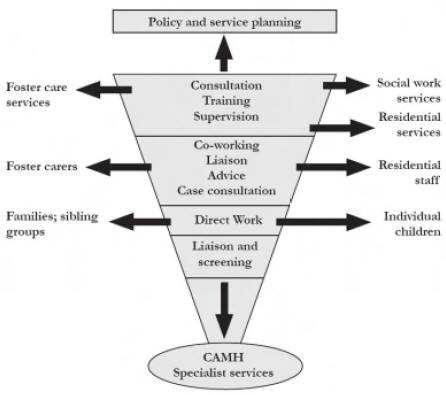
Finally, the importance of effective throughcare and aftercare services cannot be ignored. Commonly, services are not geared to sustain attention on the mental health needs of young people as they move on from care. Indeed much of the focus of care planning tends to be on practical requirements needed to support independent living with less attention to emotional and psychosocial needs. As throughcare and aftercare provision develops it will be important to redress this balance.
Conclusion
The key principles driving service and practice development in children’s services are now focusing attention on potential assets and areas of strength within the system around the child and emphasising the importance of positive relationships in nurturing self-belief and wellbeing (Scottish Executive, 2006; Daniel, 2008). This creates renewed opportunities to address the mental health and wellbeing of all children who are looked after: to identify how best to promote mental health and wellbeing; to prevent the development of mental health problems; and to assure the provision of treatment, care and support for those who require such intervention.
References
Barbour, R., Bryce, G., Connelly, G., Furnivall, J., Lewins, A., Lockhart, E., Phin, L., Stallard, A., van Beinum, M. & Wilson, P. (2006). Only Connect: Addressing the emotional needs of Scotland’s children and young people. A report on the SNAP child and adolescent mental health Phase Two survey. Edinburgh: Health Scotland.
Clough, R. Bullock, R. & Ward, A. (2006). What works in residential care: A review of research evidence and practical considerations. London: National Children’s Bureau.
Daniel, B. (2008). The concept of resilience: Messages for residential child care. Chapter in A. Kendrick, (Ed.), Residential child care: Prospects and challenges. Research highlights in social work 47. London: Jessica Kingsley
Foresight project (2009). Mental capital and wellbeing. Accessed on 18th April 2009 from here.
Happer, H, McCreadie, J. & Aldgate. J. (2006). Celebrating success: What helps looked after children succeed. Edinburgh: Social Work Inspection Agency.
Layard, R. & Dunn, J. (2009). A good childhood searching for values in a competitive age. London: Penguin Books.
McCollam, A & Woodhouse, A. (2007). Familiar challenges, promising solutions. Edinburgh Connect: a mental health consultation service for residential care staff working with looked after and accommodated children. International Journal of Child and Family Welfare, 10 (1-2), 44 – 58.
McCollam, A., O’Sullivan, C., Mukkkala, M., Stengard, E. & Rowe, P. (2008a). Mental health in the EU. Key facts, figures and activities. A background paper. Luxembourg: European Commission.
McCollam, A., Myers, F. & Watson, J.(2008b). Support for change. Approaches and models for the development of provision for children and young people’s mental health. Edinburgh: Scottish Development Centre for Mental Health.
Meltzer, H., Lader, D., Corbin, T., Goodman, R. & Ford, T. (2004). The mental health of young people looked after by local authorities in Scotland. Edinburgh: The Stationery Office.
Milligan, I. (2004). Looked after and accommodated children: The LEAP Project, Ayrshire. Glasgow: Scottish Institute for Residential Child Care.
Scottish Executive (2004). The mental health of children and young people: A framework for prevention, promotion and care. Edinburgh: Scottish Executive.
Scottish Executive (2006). Getting it right for every child. Using the resilience matrix to make sense of assessment information and evaluate children’s needs. Accessed on 2nd May 2009 from here.
Scottish Executive (2007). Looked-after children and young people: We can and must do better. Edinburgh: The Stationery Office.
Scottish Government, (2008). Equally well. Report of the ministerial task force on health inequalities. Accessed on 5th May 2009 from here.
Social Work Inspection Agency (2006). Extraordinary lives. Creating a positive future for looked-after children and young people in Scotland. Edinburgh: Social Work Inspection Agency.
Stanley, N. (2007). Young people’s and carers’ perspectives on the mental health needs of looked after adolescents. Child and Family Social Work, 12(2), 258 267.
From: The Scottish Journal of Residential Child Care, 8 (2), October 2009, pp. 1-10