































This article investigates how the concept of ‘children at risk’ is produced as a problem within public health policy. Globally and nationally, political authorities are concerned with what they consider risk factors, connected to the population’s health and well-being. One of the most common long-term health concerns is non-communicable diseases, related to sedentary behaviour and a reduced level of physical activity. Such diseases are considered by international organisations, such as the World Health Organization (WHO) and the Organisation for Economic Cooperation and Development (OECD), to be the most challenging public health concerns of our time. This chapter examines how children’s future health risk is produced and transformed in the Nordic context and investigate how the concept of ‘children at risk’ is produced as a problem in two health policy documents. The results indicate that the focus of children at risk changed in four years from kindergarten children to youth. These findings suggest various interpretations of the term ‘in the best interest of the child’, article 3, and challenge the understanding of children as active agents, article 12, in the UNs convention on the Right of the Child (United Nations, 1989). We discuss how ‘risk reduction’ tends to become ‘risk production’ through the creation of new problems, such as standardisation, variation and exclusion
Keywords
children, youth, risk, public health policy, kindergarten, school
Introduction
According to the British sociologist Nikolas Rose, political authorities, in alliance with stakeholders and others, have taken responsibility for the management of life in the name of the well-being of the population and of each of its living creatures (Rose, 2001, p. 1). Political authorities, nationally and internationally, engage in what is considered responsible activities for managing certain risk factors, which are considered to be connected to the population’s health and well-being. Drawing on Foucault’s (1997) concept of biopolitics, Rose sees the concept of risk as bound up with the desire to control, especially to control the future (Rose, 2001). Although the future is unpredictable, ideas about and hopes for possible futures are currently present and historically constituted and formative in society (Koselleck, 1985). The concept of risk reflects the social constructions of risk shared by a particular culture at a particular time in history, and the construction of risk brings into play the tensions between the future and the present. Ulrich Beck (1992) defined risk society as a society that has “systematic ways of dealing with hazards and insecurities induced and introduced by modernization itself” (Beck, 1992, p. 21), and Anthony Giddens (1999) declared that modern societies are increasingly preoccupied with the future and safety. He sees risk as a key aspect of modernity. In offering new conceptualisations of risk, these authors enhance, extend, combine and critique many existing disciplinary perspectives and theoretical approaches to risk (Ekberg, 2007). According to Skinner (2002), no concept can have a single definition or a standard meaning or conceptualisation. For instance, risk, as it relates to society and children, must be understood through context. Analysis of the rhetorical use of concepts is a way of linking political language to political action.
Policies to Address Future Risks
Ideas about future risk shape the organisation of children’s everyday lives (Biesta, 2014) and the activities and practices that take place in kindergartens and schools (Christensen & Mikkelsen, 2008; Ingulfsvann, Engelsrud, & Moe, 2020; Malone, 2007). Defining and managing risk factors for young children’s current and future health have become central elements in policy documents, curricula, didactic tools, pedagogical theories, and commercial offerings on early childhood care and education (Qvortrup, 2009). The political activities of surveillance, discipline and control of children’s present circumstances to reduce their risk of future bad health challenge the UNCRCs understanding of children as active agents (United Nations, 1989, article 12). These activities also suggest various interpretations of the term ‘in the best interest of the child’ (United Nations, 1989, article 3).
Non-communicable diseases, also referred to as lifestyle diseases, which are increasingly prevalent across the world are among the most common concerns.
Lifestyle diseases, which are connected to sedentary behaviour, reduced levels of physical activity, unhealthy eating, smoking, alcohol and other risky behaviours, are considered to be the most challenging public health concerns of our time by international organisations such as the World Health Organization (WHO) (WHO, 2018) and the Organisation for Economic Co-operation and Development (OECD) (OECD, 2016). However, the implementation of public health policy targeting these behaviours as processes has not been widely studied (Langøien et al., 2017; Muellmann et al., 2017). Health policy initiatives related to noncommunicable diseases are especially directed at children and youth in kindergarten and schools. In its global recommendations on physical activity for health (WHO, 2010), the WHO advises one hour of moderate to vigorous physical activity every day for children and youth. It is thought that physical activity for health lowers the risk of illness and earlier death (WHO, 2010) and, thus, benefits society. Advocates of this understanding of health adopt a lifelong perspective and argue that physical activity should be prioritised in kindergartens and schools for the benefit of children and the future health and well-being of youth (Borgen, 2018a, 2018b; Cigman, 2012). Within the field of health research, there is a substantial body of intervention studies and randomised controlled trials that seek evidence of the benefits of physical activity for children and youth (Adab et al., 2018; Kriemler et al., 2010; Skrede, 2019). Within education research, Thomas Popkewitz (2018) identified a paradox whereby the good intention to eliminate risks for all children excludes and abjects those who do not make the right choices:
The liberal hope of school research is to produce an inclusive society. This hope is embodied in making children as particular kinds of people, sometimes called problem-solvers and lifelong learners for that future society. But for all these good intentions, the hope of future inscribes double gestures in reform-oriented research. The hope for making kinds of people embodies fears about the dangers and dangerous populations that threaten that desired future. These ‘other’ kinds of children are distinguished as students who ‘lack motivation’ or are classified as ‘at-risk’. (Popkewitz, 2018)
Researchers tend to objectify differences for classification purposes, such as to determine who is at risk, and what kinds of risks must be addressed. When researchers describe someone as engaging in healthy behaviour, the antitype is those who do not engage in such behaviour (Popkewitz, 2018). Children and youth are objectified as ‘becomings’ (Uprichard, 2008) in these health policy initiatives. However, such initiatives also grant importance to decision making and agency to enable children and youth to become independent learners capable of taking responsibility for themselves in school and in broader society (Aarskog, Barker, & Borgen, 2018). This is an instance of the educational paradox (Løvlie, 2008). In a report on the benefits of physical education and physical activity in schools for a better future for everyone, the OECD (2019) regards the school setting as a context for health policy. However, school is also a place for students to develop agency and individual responsibility:
Schools are not just places where students go to pursue academic achievement: schools should be nurturing environments that develop the whole child, including their social, emotional, physical and mental well-being. If children and young people are to become responsible, productive and happy members of society, they need a holistic education that prepares them not just for cognitive tasks, but for the broad gamut of personal, social and professional opportunities, challenges and duties in life. (OECD, 2019, p. 3)
State-organised or state-supported initiatives in the interests of the health of the population have played a role in politics in many liberal democratic societies in the twentieth century (Rose, 2001, p. 6). In Nordic countries – which have small populations, the highest global quality of life rankings, and a “paradoxical blend of social democracy and liberalism” (Tin, Telseth, Tangen, & Giulianotti, 2019) global health policies and recommendations influence everyday life and physical culture in kindergarten and schools.1 In Norway, risk-reducing public health policies are described in white papers (Meld. St.), which are presented to the Storting (parliament) to explain the work being conducted in a particular field and guide future policy-making. These white papers and discussions of them in the Storting often form a basis for a draft resolution or bill. They are accompanying documents that describe the aims of policies, norms and recommendations and are seen as guidelines for local practice.
This article examines the research question: How is the concept of the future health risks of children and youth presented in two recent Norwegian public health white papers, which were produced by the same government within four years? (Ministry of Health and Care Services, 2015, 2019). We are interested in the similarities and differences between these policy documents, which were published within a relatively short period. The documents are as follows:
What Is the Problem – What Is at Risk?
According to Carol Bacchi (1999), how we perceive or think about something will affect what we think ought to be done, and, at its most basic, this insight is commonsensical. She suggests that every political call for action or solutions inevitably and in various ways defines a problem to be solved (Bacchi, 1999). One example of what Bacchi (2016) calls ‘mainstream health policy theorizing’ can be found in the WHO’s (2015) Health in All Policies Manual, which defines four stages of policy-making: agenda-setting (e.g. identification of the problem), policy formation, policy implementation and policy review (e.g. monitoring, evaluation, and reporting) (Bacchi, 2016, p. 4). The white papers on public health policy analysed here have this structure. Bacchi (2016) argues for an alternative approach. She advocates examining policy proposals and policy instruments, such as childcare or health policies, to uncover problem representations. She reminds us that the banal and vague notions of ‘the problem’ and its partner ‘the solution’ are heavily laden with meaning (Carson, 2018). Bacchi starts from the position that problems are not given but instead are social constructions and, therefore, contextual. She challenges the idea that governments react to pre-existing problems and instead argues that they are active in creating problems. For Bacchi, focusing on problematisations rather than problems sheds light on the role problems play in governing processes. Bacchi’s approach to analysing policies aimed at addressing social problems is the ‘What’s the Problem Represented to be?’ (WPR) approach and is guided by six questions.2 First, it is necessary to consider what the problem is represented as in the policy or policy proposal that is being studied (e.g., children’s risk of developing bad health) and what presuppositions or assumptions underpin this representation of the problem. It is also worth considering how the representation of the problem has come about and what is left unproblematised in that representation. The effects produced by the representation of the problem and how this representation of the problem has been produced, disseminated and defended is important for identifying solutions that may be unintentionally harmful. According to Bacchi’s Foucauldian poststructuralist approach to policy analysis, the WPR approach is a methodological approach to studying policy (Bacchi, 2016, p. 1). It goes beyond the question of what the subject of politics is and asks how something has become the subject of politics.
Inspired by the critical question ‘what is the problem?’ (Bacchi, 1999), we draw on Bacchi’s WPR methodology and qualitative content analysis (Hsieh & Shannon, 2005) to answer the research question. Our study includes both quantitative and qualitative content analysis of the two policy documents. First, we conducted a summative content analysis, which involved counting words selected by the authors to represent the categories derived from the text data in the two documents for the purpose of comparison. This was followed by an interpretation of the underlying context. According to Bacchi (2016, p. 10), a summative content analysis of how problems are conceptualised within policy documents is useful for a WPR analysis. We then conducted a qualitative conventional content analysis (Hsieh & Shannon, 2005) of the two documents. Categories were derived directly from the text data in accordance with the WPR approach. The white papers were examined for content on physical activity in relation to children and adolescents, the risks related to this subject, and future prospect for children and youth. By focusing on these topics in our initial examination of the documents, we sought to reveal a possible narrative about physical activity, children, youth and health in these documents. We focused on what the problem was represented as in the white papers and asked what presuppositions or assumptions underpinned this representation of the problem. In other words, we began by looking for the proposed solution(s) and derived from these ask what the problem was represented as. In dialogue with the critical literature on risk society, we read and re-read the documents to identify the assumptions behind their understanding of the problem that could be solved by the proposed solution or activity. In the next section, we present our summative content analysis, followed by a textual analysis of a selection of excerpts from the documents being investigated.
Risk as an Element of Politics
First, we conducted a count of words in the two policy documents (A and B) to identify consistencies and changes between 2015 and 2019 in public health policy messages between 2015 and 2019 (see Table 9.1). We defined two categories, ‘children’ and ‘risk’, and, informed by recent health policy research, searched for words connected to those categories.3
Change of Scope from Children to Youth
The word ‘child’, either alone or in combination with an institution or service (e.g. child welfare, child policy initiatives), is mentioned 908 times in Document A and 726 times in Document B (see Table 9.1). By contrast, the word ‘youth’, either alone or in combination with an institution or service, is mentioned more often in Document B (564 times) than in Document A (490 times). In Norwegian, the phrase ‘children and youth’ refers to the UNCRC definition of children (0–18 years) and is used more often in Document B than in Document A. As an institutional context, ‘kindergarten’ is mentioned more often in Document A than in Document B, whereas ‘school’ is mentioned more often in Document B than in Document A. However, the compound phrase ‘kindergarten and school’ is mentioned in combination with services (e.g., health services and policy initiatives) in both documents. While ‘family’ is only occasionally mentioned, kindergartens, schools, public institutions and services are frequently mentioned as instruments for health policy in these documents. The more frequent mention of ‘child’ in Document A than in Document B indicates that the policy proposed in Document A is aimed at young children.
Table 9.1
Words related to
public health policy in two Public Health White papers (Documents A & B)
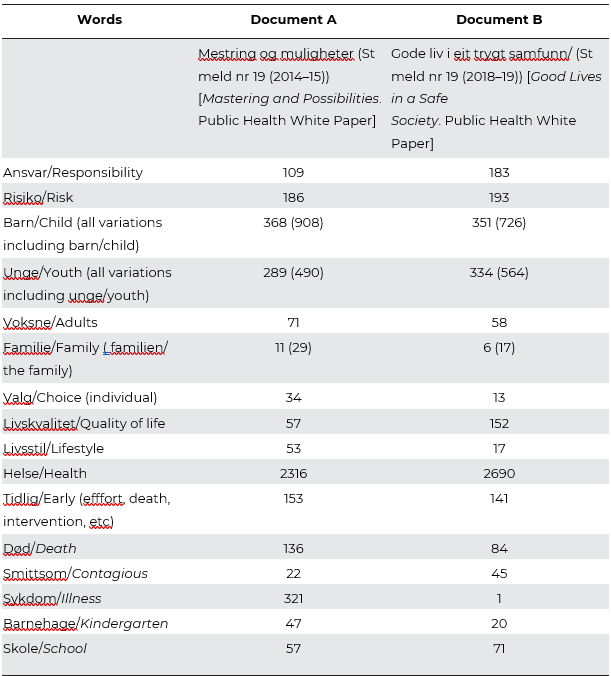
Some words were used infrequently but, when they were used, were associated with strong normative and often leading statements, whereas some frequently mentioned words were used in weak statements. For instance, in Document A, ‘choice’ is mentioned 34 times, and ‘health-friendly choices’, which we consider making a strong statement about what individuals do or should do, is mentioned 13 times. In Document B, we find ‘choice’ once in the phrase ‘responsible choices of life’ and 12 times in the phrase ‘health-friendly choices’. We consider ‘choices of life’ to make a strong statement due to the context within which it is mentioned, that is, the new Norwegian curriculum reform in compulsory education, which is being launched in 2020. The topic of public health and life mastery is one of three priority interdisciplinary topics in this new curriculum, which, according to Document B, “will help students gain competencies that promote good mental and physical health, and that gives them the power to make responsible choices of life” (p. 31). Thus, children of kindergarten age are the target of the health policy in Document A, while the policy in Document B appears to target children and youth of school age. Another example is the phrase ‘quality of life’, which is mentioned three times more frequently in Document B than in Document A. However, the compound phrase ‘quality of life and well-being’ is used in Document A only, while ‘health and quality of life’ is used most frequently in relation to statements about the objectives for the health policy in Document B. ‘Illness’ is a frequently used word in Document A (occurring 321 times) in statements about problems that health policy initiatives should solve, whereas ‘illness’ is mentioned only once in Document B.
The word counting exercise revealed distinct differences in scope between the two documents. Document A frequently mentions ‘child’ in connection with a wide range of institutional contexts and policy initiatives, whereas the term is used within a narrower context in Document B. The term ‘youth’ is mentioned more frequently in Document B than in Document A, while children and youth appear to be given equal emphasis in Document B in terms of the frequency with which they are mentioned. Compared to Document A, Document B appears to grant more attention to structural framework conditions (e.g., meta-concepts such as quality of life and early interventions for children and youth) and less attention to individual choices and action. Although risk appears to be an element of politics common to the two documents, the two documents reveal a considerable change of scope within four years.
From Individual Action to Structures and Arenas
For the initial conventional content analysis of the two policy documents, categories were derived directly from the Norwegian text data. The excerpts (our translation) are presented in block quote, while our analysis is presented in plain text.
A Negative Trend about What?
The population, which includes children, is less physically active now than before and does not meet the health recommendations for physical activity. About 2.5 million people do not meet the health recommendations for physical activity. Adults spend an average of nine hours of their waking time at rest. Sitting for extended periods is a risk factor for illness and health problems. (Document A, p. 14)
Children are included in this overview of a negative trend of insufficient physical activity. Within a physical activity–health paradigm, activity level and health are considered to be causally related. To be less active means to be less healthy. In the given context of the above statement, characterising physical activity among children as ‘less than before’ constructs or creates a problem based on weak evidence, general assumptions and unsubstantiated opinions. Data is lacking on previous levels of activity among children, as this type of measurement has only been conducted in recent years and only occasionally, not systematically. In contrast to the assertion made above, the Norwegian Institute of Public Health (NIPH) reported in 2017 that most children (as much as 80–90%) in Norway were physically active in line with governmental recommendations. This means that the problem is considered to be that children are becoming less active. However, if less is still enough for the vast majority of the child population, what is the problem? By reporting that children do not meet government recommendations, the document portrays children as problems in themselves. The implied narrative is that the authorities recommend that the population, including children, increase their level of physical activity level, but the population, children included, do not follow this recommendation. They do not make the right choices. Are children ignorant, unwilling or unable to be sufficiently physically active? What, according to the authorities, is the problem with not being sufficiently physically active?
Why Is Physical Activity Such a Concern?
Non-communicable diseases are the main cause of early death and early loss of quality of life. The solutions to this problem include physical activity, a healthy diet, a smoke-free environment and moderation in alcohol consumption. (Document A, p. 14)
To create more quality years of life and increase life expectancy, the government, in line with the WHO’s global goals, will continue its efforts to reduce the incidence of premature death and health problems due to non-communicable diseases. (Document B, p. 105)
As these excerpts indicate, physical activity is seen as a vital risk-reducing behaviour. It is implied that the risks of future disease, loss of quality of life and early death can be addressed by engaging in healthy behaviour and sufficient levels of physical activity during childhood. Physical activity is seen as a tool and as part of a dose-response framework that will yield calculated results in the future on both an individual level and a public health level. However, proposing the risk of future disease as a reason for physical activity constitutes an oversimplification of the solution. It suggests that one risks acquiring these kinds of diseases if one does not engage in certain behaviours, such as being sufficiently physically active and eating healthy food. According to Document B, the work will continue as recommended by WHO.
Society Must Take Responsibility
A society that facilitates good health choices is a prerequisite for enabling individuals to take responsibility for their own health. The government will work to ensure that healthy choices are simple and natural choices for everyone. Organisation of physical activity is important and must take place within all sectors. (Document A, p. 9)
Being able to make good health choices is a prerequisite for the good health of the individual. The government aims to expand its work of facilitating health-friendly choices by promoting increased physical activity, a better diet and less use of tobacco and intoxicants. Society must make healthy choices easy choices. More emphasis should be placed on how to make information on health-friendly choices available to everyone. It is important for the individual to make informed choices. (Document B, p. 20)
The above statements imply that the population does not take responsibility for its own health, at least not when it comes to being physically active. Thus, the health authorities deem it necessary to take charge to ensure that the population itself can take such responsibility by facilitating increased physical activity in all sectors of society. Once this is achieved, the responsibility lies with the people themselves. More organised opportunities for physical activity appear to be the solution to the problem – a problem represented as people failing to take responsibility for their health by not being sufficiently physically active. The implication is that if there are enough opportunities to participate in physical activity, the population will make use of these opportunities and take responsibility for their health, both now and in the future.
Responsibility for What?
All children and adolescents must be given opportunities for mastery and development. These opportunities include good living and upbringing conditions that promote mental health, opportunities for a healthy diet, physical activity in kindergartens and schools, and tobacco-free surroundings. The foundations for good health and good health habits are laid early and remain important throughout a person’s entire lifetime. (Document A, p. 12)
A balance must be struck between community responsibility for the health of inhabitants and the individual’s responsibility for their own health. At the same time, there must be a balance in the instruments that are used, so that one respects the freedom of the individual. (Document B, p. 143)
Children and adolescents, as segments of the population, are of special interest. Since ways of living and living habits are decided during childhood, encouraging healthy habits in this period of life is seen as crucial for producing healthy adults. To ensure good health habits during the early years of life, health authorities emphasise the importance of upbringing conditions. The upbringing conditions in focus are mental health, healthy diet, physical activity and smoke-free surroundings. It is implied that these are of vital importance if children and youth are to establish healthy habits and be capable of taking care of themselves and taking responsibility for their own health as adults. However, it is also stressed that children and young people must be given the opportunity to experience mastery and development. How is this to be understood in relation to the focus on upbringing conditions that promote good mental health, a healthy diet and adequate physical activity? Could it be that eating properly, being sufficiently physically active and keeping their mood up or looking on the bright side of life enables children to feel that they can master various challenges in life and, thereby, develop in a positive direction to become healthy adult citizens?
If the solution is healthy diet, sufficient physical activity and smoke-free surroundings, enabling children to achieve mastery and development and, thereby, become healthy individuals, the problem might be understood as a problem with children and young people’s development, that is, that they do not develop in the ‘right way’. The assumption underlying these solutions appear to suggest that environmental conditions (e.g. the actions of parents and other guardians) are the fundamental prerequisites for healthy development during childhood and into adulthood. However, the role of the family is not mentioned. Rather, it is implied that the responsibility for making the right choices is that of the individual and is portrayed as an expression of the freedom of the individual.
Discussion
We have asked the following questions: What do the documents say? What is the problem? What is at risk? What problematisation can be revealed? Here, we elaborate on the results of the textual analysis, focusing on the solutions to the represented problem of children being at risk offered in the documents. We consider the implied or unquestioned presuppositions that underlie the problem represented and explore the effects that might result from this representation of the problem. Using a WPR approach, we read the documents that constituted our material in this study with the purpose of discerning how the problem was represented within the documents and subjecting this problem representation to critical scrutiny. In accordance with the WPR method, we posed the six questions of our material and of ourselves as researchers.
Political Vigour
Public health policy attempts to exhibit political vigour by drawing a rather gloomy picture of the future. In this picture, most people are unable to live their lives so that they become financially productive without political pressure. A modern society without social and normative guidelines will result in fat, sick and lazy adults in the future. Education is aimed at making children and young people into useful citizens in the future. In Document A, the future is manifest in the kindergarten child. Children are not physically active enough and move too little to become the healthy adults that political authorities portray as ideal. Children are a focus area, and kindergarten is presented as the main arena in which risk-reducing practices can be employed. To eliminate unhealthy and risk-producing practices, kindergartens should be guided to establish new standards for physical activity and meals. It is through these institutions and policy initiatives that the government will facilitate good health choices.
The message in Document B is that children in kindergarten are the most physically active segment of the population. Thus, what was described as a major public health problem in Document A might not be a problem in Document B (i.e., four years later). In Document B, it is young people who are the targets for new measures to increase physical activity, and they are the ones who should make good health choices. Did Document A create a problem that was not yet there? Does ‘risk reduction’ tend to become ‘risk production’ by creating new problems, such as standardisation, variation and exclusion? For instance, the measures to increase physical activity among children in kindergartens described in Document A as necessary to prevent the health risk problem have already been initiated and have become standard in Norwegian kindergartens (Grorud District, 2014).
What Is too Little?
The concrete claims in both documents are that today’s children and youth are not active enough and are less active than before. This generates a norm of what children should be and indicates what they should not be. The documents convey the message that this issue (citizen health) is out of control. This is an expression of the educational paradox: children and young people should have freedom of choice but must be guided to make the right choices to reach the prescribed level of health in the future. In Document A, kindergarten children are ordered to move in specific ways chosen by adults. In Document B, the youth should make good choices themselves. We could characterise this as a health education paradox (cf. Løvlie, 2008).
How Has This Representation of the Problem Come About?
Today, access to “big data” has increased. These data provide grounds for associations between phenomena and are interpreted as explanatory conditions. Researchers and politicians can problematise both one and the other as problems and use data to problematise in new ways. Access to these new data changes how we view problems and enables us to discover new problems that were not apparent before. Time is interesting here. The past is somewhat unclear. We do not know what has happened before, and instead, we predict risks on the basis of which we act in the present for the future.
What Is Silently Understood?
The child, here and now, is silently understood as a future adult. The responsibility to act in the present to become a good citizen in the future is placed on the individual. Physical activity is represented as an instrumental force. The child is equated to their physical activity and the amount of that activity. This objectification of the child is far from the UNCRC’s concept of the child as an individual who has a right to express their views freely in all matters affecting them and whose views should be given due weight in accordance with their age and maturity (article 12) (United Nations, 1989). The child is understood as a future adult who is healthy and not sick. It is taken for granted that action here and now will provide future gains. However, the WHO’s (2010) recommendation is aimed at children aged between 5 and 17. It remains unchallenged whether these recommendations for older children are useful for children aged between 1 and 5, which is the age of kindergarten children in Norway.
This health policy paradox places responsibility on children and youth, while at the same time prescribing that the adults must do something about the problem and control the children and young people. The policy is silent on how adults decide on the benefits of certain activities for children and youth. It seems unclear whether the problem lies with the children and youth or with society. Politicians and bureaucrats can propose measures, which are implemented as practices in kindergarten and schools. This must be operationalised within specific contexts. People must do new things, and this creates new economies and practices, for instance physical activity experts and physical activity programs in kindergarten and schools. The concerns for the sick adult are paradoxical. We do not know whether the measures targeting schools and kindergartens will lead to healthier adults.
How Can the Represented Problem Be Challenged, Disrupted and Replaced?
Children are movement-oriented, and we are all moving beings (SheetsJohnstone, 2011). How, then, do we regulate movement in society? Is it a cause for concern that children are moving less than before? What do we end up with if children are less physically active than before? There is silence regarding what the children can use their new-found time for or what they might gain by moving less. Such gains could include rest, artistic experience, environmental awareness, social participation and the development of citizenship and democratic competencies.
In the two public health policy documents examined in this study, physical activity is presented as similar to health; this health concept is instrumental and behaviourally understood. Physical activity is understood as a double benefit for children insofar as it benefits them both in the present and the future. However, if it is linked to risk, its non-occurrence becomes a deficiency. Reports on physical activity and health have an instructive character. When they are translated and operationalised within local contexts, the linguistic implications are expressed through practitioners attempts to translate documents into practices, with the result that practices are categorical and standardised, rather than adapted to contexts.
Conclusion
What is at risk? Childhood as a purpose and not a goal in and of itself becomes the basis for action. When children and youth are projected as objects rather than actors and reduced to their quantified behaviour, they are understood as becomings and not as beings of becomings (Uprichard, 2008). This perspective contradicts that of the UNCRC, which regards children as active agents, capable of reflecting upon and speaking about their own situation and of being entitled to speak freely about it (article 12) (United Nations, 1989). It may also contradict society’s view of health. Society does not see health solely in terms of disease and a future synonymous with the risk of illness and early death. It does regard future health as inseparable from history and the present (Koselleck, 1985). In a Nordic – and, more specifically, Norwegian – cultural context, children’s present and future well-being and health are seen as deeply connected to their access to privacy, free play and freedom to spend time away from adult surveillance and discipline. Norwegian public health policy, which is highly influenced by the WHO’s policy (2010, 2015), is based on a precautionary principle that appears to be very effective. In this public health policy, variation among children and youth is represented as a problem and provides a ground for continuous linking of political language to political action (Skinner, 2002).
The Norwegian government’s management of life in the name of the wellbeing of the population (Rose, 2001), as a translation of the WHO’s global health policy, appears to lose sight of the fact that although they live in the best of societies, large groups of the population are projected as the antitype of those who engage in healthy behaviour (Popkewitz, 2018) and make judicious life choices. Peters (2018) argues that global challenges, such as climate change, food insecurity, massive migration, refugee crises and emerging and re-emerging diseases, are mutually reinforcing and cause the greatest harm to the most vulnerable populations. When policy-makers focus on the physical activity and individual choices of children and youth and when more global challenges, such as the covid-19 pandemic in 2020, remain on the periphery of public health policy-making, it is clear that considerable changes in our dialogue relating to risks and health policy nationally and globally are required.
Notes
References
Aarskog, E., Barker, D., & Borgen, J. S. (2018). What were you thinking? A methodological approach for exploring decision-making and learning in physical education. Sport, Education and Society. https://doi.org/10.1080/13573322.2018.1491836
Adab, P., Pallan, M., Lancashire, E. R., Hemming, K., Frew, E., Barret, T., … Cheng, K. K. (2018). Effectiveness of a childhood obesity prevention programme delivered through schools, targeting 6 and 7 year olds: Cluster randomised controlled trial (WAVES study). BMJ 2018, 360. https://doi.org/10.1136/bmj.k211
Bacchi, C. (1999). Women, policy and politics: The construction of policy problems. Sage Publications. http://dx.doi.org/10.4135/9781446217887.
Bacchi, C. (2016). Problematizations in health policy: Questioning how ‘problems’ are constituted in policies. Sage Open. https://doi.org/10.1177/2158244016653986
Beck, U. (1992). Risk society: Towards a new modernity. Sage.
Biesta, G. J. J. (2014). The beautiful risk of education. Paradigm Publishers.
Borgen, J. S. (2018a, June 28). Monitoring of quality PE – From a Norwegian perspective: Realities and perspectives. Paper presented at the meeting of the Conceil Europeen des Rescherches en Education Physique et Sportive (CEREPS) 2018, Workshops, University of Lisbon, Lisbon, Portugal.
Borgen, J. S. (2018b). International comparative review of physical education. OECD education 2030 in-depth analysis of Physical Education (PE) in 12 countries [Report prepared under the auspices of the OECD Future of Education and Skills 2030 project]. Norwegian School of Sport Sciences.
Carson, L. (2018, February 13). The politics of the problem: How to use Carol Bacchi’s work. Power to Persuade. http://www.powertopersuade.org.au/blog/the-politics-of-theproblem-using-carol/12/2/2018
Christensen, P., & Mikkelsen, M. R. (2008). Jumping off and being careful: Children’s strategies of risk management in everyday life. Sociology of Health & Illness, 30(1), 112–130. https://doi.org/10.1111/j.1467-9566.2007.01046.x
Cigman, R. (2012). We need to talk about well-being. Research Papers in Education, 274(4), 449–462. https://doi.org/10.1080/02671522.2012.690238
Ekberg, M. (2007). The parameters of the risk society: A review and exploration. Current Sociology, 55(3), 343–366. https://doi.org/10.1177/0011392107076080
Foucalt, M. (1997). The birth of biopolitics. In P. Rabinow (Ed.), Michel Foucault, ethics: Subjectivity and truth (pp. 73–9). The New Press.
Giddens, A. (1998). Risk society: The context of british politics. In J. Franklin (Ed.), The politics of risk society order. Polity Press.
Grorud District. (2014). The Grorud standard for public health work in kindergarten. Grorud District.
Hsieh, H.-F., & Shannon, S. E. (2005). Three approaches to qualitative content analysis. Qualitative Health Research, 15(9), 1277–1288. http://journals.sagepub.com/doi/ 10.1177/1049732305276687
Ingulfsvann, L. S., Engelsrud, G., & Moe, V. F. (2020). Tensions and tractions of moving together and alone in physical education. Sport, Education and Society. https://doi.org/10.1080/13573322.2020.1712654
Koselleck, R. (1985). Futures past: On the semantics of historical time. Columbia University Press.
Kriemler, S., Zahner, L., Schindler, C., Meyer, U., Hartmann, T., Hebestreit, H., … & Puder, J. J. (2010). Effect of school based physical activity programme (KISS) on fitness and adiposity in primary schoolchildren: Cluster randomised controlled trial. BMJ, 340, c785. https://doi.org/10.1136/bmj.c785
Langøien, L. J., Terragni, L., Rugseth, G., Nicolaou, M., Holdsworth, M., Stronks, K., Lien, N., & Roo, G. (2017). Systematic mapping review of the factors influencing physical activity and sedentary behaviour in ethnic minority groups in Europe: A DEDIPAC study. International Journal of Behavioral Nutrition and Physical Activity, 14(99), 1–24. https://doi.org/10.1186/s12966-017-0554-3
Løvlie, L. (2008, March 28). The pedagogical paradox and its relevance for education. Paper presented at The Philosophy of Education Society of Great Britain (PESGB) Annual Conference, Oxford. https://www.researchgate.net/profile/Lars_Lovlie2/ publication/242678544_The_Pedagogical_Paradox_and_its_Relevance_for_ Education/links/56a6183d08ae2c689d39d060.pdf
Malone, K. (2007). The bubble‐wrap generation: Children growing up in walled gardens. Environmental Education Research, 13(4), 513–527. https://doi.org/10.1080/ 13504620701581612
Muellmann, S., Steenbock, B., De Cocker, K. De Craemer, M., Hayes, C., O’Shea, M. P., … Pischke, C. R. (2017). Views of policy makers and health promotion professionals on factors facilitating implementation and maintenance of interventions and policies promoting physical activity and healthy eating: Results of the DEDIPAC project. BMC Public Health, 17(932), 1–17. https://doi.org/10.1186/s12889-017-4929-9; doi:10.1186/s12889-017-4929-9
Norwegian Institute of Public Health (NIPH). (2017). Physical activity in Norway. Public Health report. Norwegian Institute of Public Health. https://www.fhi.no/nettpub/ hin/levevaner/fysisk-aktivitet/
OECD. (2016). The future of education and skills. Education 2030 (Position paper). Author. https://www.oecd.org/education/2030/E2030%20Position%20Paper%20 (05.04.2018).pdf
OECD. (2017). PISA 2015 results: Students’ well-being, PISA (Vol. III). http://dx.doi.org/ 10.1787/9789264273856-en
OECD. (2019). OECD future of education 2030. Making physical education dynamic and inclusive for 2030. International curriculum analysis. https://www.oecd.org/ education/2030-project/contact/OECD_FUTURE_OF_EDUCATION_2030_ MAKING_PHYSICAL_DYNAMIC_AND_INCLUSIVE_FOR_2030.pdf
Peters, D. H. (2018). Health policy and systems research: The future of the field. Health Research Policy and Systems, 16(84). https://doi.org/10.1186/s12961-018-0359-0
Popkewitz, T. (2018, September 6). The paradox of research: The good intentions of inclusion that excludes and abjects. Keynote presented at European Conference on Educational Research (ECER) 2018 Conference, Bolzano. https://eera-ecer.de/ecer2018-bolzano/whats-on/keynote-speakers-keynote-panel/thomas-popkewitz/
Qvortrup, J. (2009). Childhood as a structural form. In J. Qvortrup, W. A. Corsaro, & M. S. Honig (Eds.), The Palgrave handbook of childhood studies (pp. 21–33). Palgrave Macmillan.
Ministry of Health and Care Services. (2015). Folkehelsemeldingen. Mestring og muligheter (Meld. St. 19 (2014–2015)) [Mastering and possibilities. Public Health White Paper 19 (2014–2015)].
Ministry of Health and Care Services. (2019). Folkehelsemeldinga. Gode liv i eit trygt samfunn (Meld. St. 19 (2018–2019)) [Good lives in a safe society. Public Health White Paper 19 (2018–2019)]. https://www.regjeringen.no/no/dokumenter/meld.-st.-19- 20182019/id2639770/
Rose, N. (2001). The politics of life itself. Theory, Culture and Society, 18(6), 1–30.
Sheets-Johnstone, M. (2011). The primacy of movement (exp. 2nd ed.). John Benjamins Publishing.
Skinner, Q. (2002). Visions of politics: Regarding method (Vol. 1). Cambridge University Press. https://doi.org/10.1017/CBO9780511790812
Skrede, T. (2019). Prospective associations between sedentary time, physical activity and cardiometabolic risk factors in children: The active smarter kids study (Unpublished doctoral dissertation). Norwegian School of Sport Sciences.
Tin, M. B., Telseth, F., Tangen, J. O., & Giulianotti, R. (Eds.). (2019). The Nordic model and physical culture. Routledge.
United Nations (1989). United Nations Convention on the Right of the Child (UNCRC). Retrieved April 21, 2020, from https://downloads.unicef.org.uk/wp-content/uploads/2010/05/UNCRC_united_nations_convention_on_the_rights_of_the_ child.pdf?_ga=2.259582415.454887985.1587459175-44770236.1585716747
Uprichard, E. (2008). Children as beings and becomings: Children, childhood, and temporality. Children and Society, 22(4), 303–313.
WHO. (1990). Prevention in childhood of adult cardiovascular diseases: Time for action. Report of a WHO Expert Committee (Technical report series, World Health Organization). Author.
WHO. (2010). Recommendations on physical activity for health. Author.
WHO. (2015). Health in all policies: Training manual. Author. https://www.who.int/ social_determinants/publications/9789241507981/en/
WHO. (2018). Factsheet: Physical activity and young people. Author. http://www.who.int/ dietphysicalactivity/factsheet_young_people/en/
From: Childhood Cultures in Transformation: 30 Years of the UN Convention on the Rights of the Child in Action towards Sustainability, pp 178–196 https://doi.org/10.1163/9789004445666_009