































Our ethical guidelines suggest that we ought to know what we aim to be doing in clients’ lives and we ought to be able to know it when we see it. This means that it can be measured. Not everything that can be measured ought to be, but we want to measure our primary goals in the care of youth. If we do not, we do not know when we have done enough—or not enough.
Sometimes we measure increases and sometimes we measure decreases. We measure increases in prosocial attitudes, behavior, empathy, cognitive complexity, and skill development. We measure declines in self-destructive behavior and violence.
A reason for measuring is that we want an objective point of view so that personal biases do not color our judgments about youth, and they always do. In my view this is an important but rarely discussed workplace challenge. We work hard to develop relationships, but our professional judgement is skewed by our personal point of view. We need information not dependent on our own personal experience.
It is not hard to collect a bit of data every week and to track how it is going. It can be graphed, like this, in Figure 1.
Figure 1
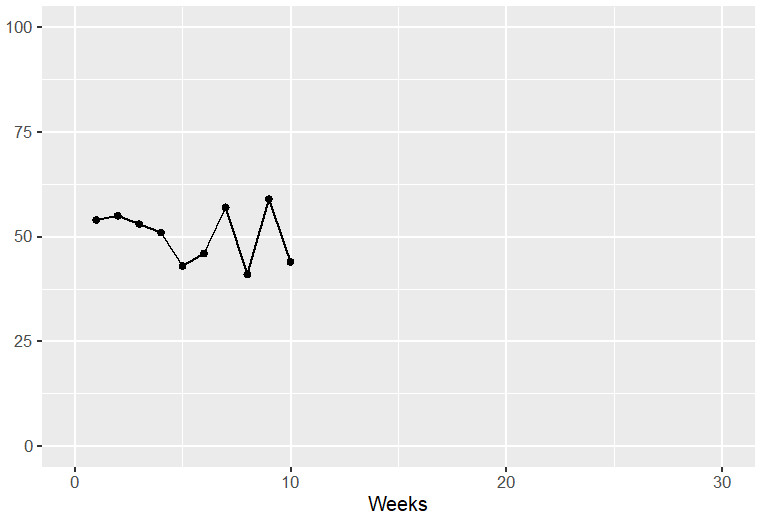
Weeks are the x-axis, and the scores of your variable are on the y-axis. The time period can vary by what makes sense for your program and your measurement variable, e.g., weeks or days, or can it vary by activity, such as during or after every participation in community recreation.
If you are changing the intervention or treatment method, changing staff, changing contact time, or anything else, you can track before and after scores, and you can mark the date of the change with a line, like this in Figure 2.
Figure 2
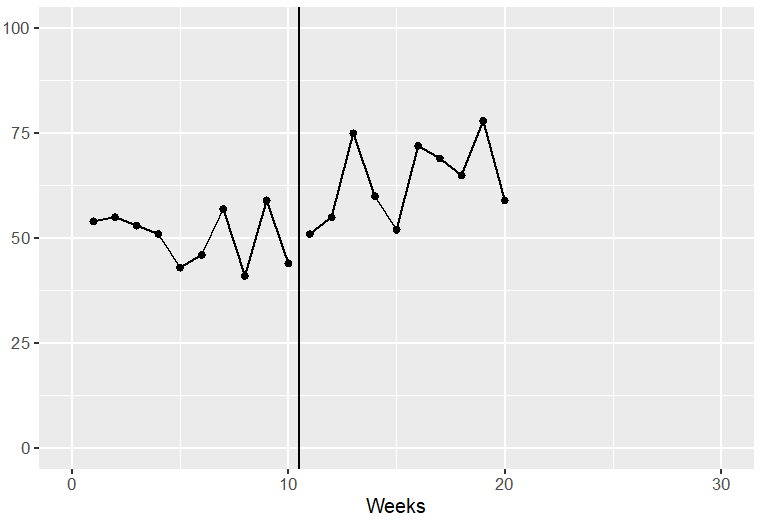
This is an “AB” design, and there are many other ways to divide the timeline. The point is to document major changes in the care of a youth. In this AB design, we might be implementing a new treatment.
One can compare the before and after periods visually: which direction are the lines and points headed? There are also methods of increasing statistical sophistication such as the percentage of overlapping points and the two-standard deviation difference.
It is important to remember that this process can included in conversations with youth. You can set a target that when reached means they can graduate, move to a different facility, or have different level of care. It is a contract with them. In research, this is a problem, because the measurement affects the score. In work with youth, there is nothing wrong with youth knowing what is being measured and responding to it.
When I visit programs, it is discouraging how few are measuring anything. They have no idea whether they are effective or not. This is bad for staff and youth morale. Some rely on expert opinion, without any idea what that expert has to contribute. The worry is that it becomes all about power over the youth, and sometimes power over the staff. Instead, we want to be precise about what they know and forthcoming about how they know it.
References
For an example of published research using a single subject design
see:
Spaid, W. (2004). The use of guided imagery for cocaine abuse.
Journal of Evidence-based Social Work(1:4), 83-96.
Instructions
for single-subject work can be found in:
Horner, R. H., et al.
(2005). The use of single-subject research to identify evidence-based
practice in special education. Exceptional Children,(71), 165-179.
If you want to geek out, there are 700 pages on the method at:
Bloom,
M., Fischer, J., & Ormer, J. G. (2006). Evaluating practice: guidelines
for the accountable professional. Pearson