
































I cannot sleep, I cannot write. Things are no longer right with the world. The air is heavy with a cloud of smoke so pronounced you would think the fire is on the block somewhere. In the cool of the early morning hours the smell of that smoke reminds one the embers of a wood fire dying out yet flickering with life. There has been a heat dome as they explain it, a pronounced stalling of the weather currents leading to a month of plus thirty-degree temperatures which extends across western Canada. The fields and the forests have become tinder to hundreds of fires across the prairies and bushlands. Meanwhile there is massive flooding in Europe and China. Lockdown against Covid-19 and the world’s greatest nation being crippled by the insurrection inspired by a president who has never really worked a day in his life living in a personal La-La Land. It is like we have been on a strange voyage, a flight or cruise in which things may have shifted in transit and so to use caution when checking your luggage. The recent discovery of 215 bodies in a mass grave through digital radar mapping on the grounds of a former residential school has revived, sharpened and extended the debates around indigenous peoples and racism in Canada. The concern here for me is these actions and sentiments may sooth the hurt feelings but do so at the expense of our history and possibly threaten the tenuous balancing act our national federation is.
Canada has had the misfortune of being a nation caught in this perpetual adolescence where it is all growth spurt and little else. We collectively do not take the time to listen to ourselves whatever the era. The fathers of the residential school movement which also spread its way to South Africa and elsewhere in the Commonwealth back in the day were driven by notion of their having this manifest destiny to explore, exploit and populate all this new land while neutralizing the influence of its inhabitants. The sun literally never stopped shining on the British Empire and they were too hopped up on their power and their fear to apply sane thinking. This continues today as suburbs continue to expand, Canada becomes even more multi-racial, and aspects of our history continue to pop up and blindside us. This is paralleled to some extent by the Black Lives Matter movement in the United States. Wakening became a good term for seeing things in a new light. This column explores my own wakening regarding indigenous peoples and culture. As such, it is often a series of recollections and impressions experienced as a child, young adult, and as a child and youth care practitioner. As statues are pulled down including that of a living Queen, the world has turned on its head as these emotions flare up and flame out.
It is hard to believe that something as simple and basic as the vote for indigenous persons only became a reality in my lifetime, in fact ten years into that lifetime, 1960. Still, those manifest issues were still there at the time. Bill Erasmus, national chief of the Dene Nation commented at the time: “… Erasmus said Diefenbaker went ahead with something that fundamentally affected the nation-to-nation basis of treaties with the Crown, and he did it without any meaningful consultation with First Nations people. "That's what the whole exercise was about. It was to make us Canadians, and we never had a discussion about that."1
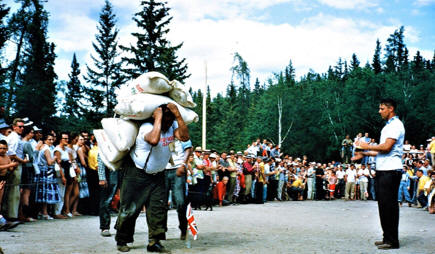
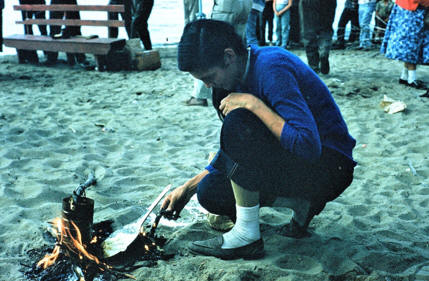
This image taken by my father, Clarence Goodwin of the flour packing on Beaver Lake Day, as they called it, a day of three set aside to explore our northern lakes, fishing and lifestyle. I often wonder if that is the ten-year-old me on the far right. The flour packing was meant to approximate what it may have been like to haul beaver pelts out of the country when the British first went inland. The man is carrying 4, 100-pound bags and 2, 50-pound bags, 500 pounds. In adulthood, on a visit to Fort William Historical Park in Thunder Bay it all was explained. Yes, the indigenous people of the time worked with, worked for and intermarried with the fur traders who explored the country, trapped and traded for essentials to supply the British with the felt needed for their top hats for the opera. The fur was taken off the skins, pressed, dried and wrapped to go up to Montreal and on to London. After getting his round feet in, the top packer took a cash prize and his share of the flour. I do not believe the event continues. In today’s atmosphere it would be misunderstood and viewed as exploitive. Indeed, now after experiencing powwows, sacred arbors and various ceremonies these contests were something an exclusive white audience would understand as opposed to traditional drumming, regalia, and dances would require learning. I now suspect it was kept private and sacred by the indigenous leaders of the time having been banned for decades. Women had their demonstration and contest as well. Each were given a bundle of wood, flint, a hatchet, tea, a clean tin full of water, an enamel fry pan, 5 pounds of flour, salt, baking powder and a pound of lard. They had to strike a fire, mix up and cook the Bannock and brew tea with the first finished getting the cash prize in addition to what hardware they wished to keep. Making Bannock goes on in kitchens and campgrounds across the country to this day. It is an honour and joy to have traditional fry bread with butter and jam made for you. Again, a remnant of another time when meals were made and taken on the fly as there was work to be done. I lived 20 miles from this reserve and only saw it the one day a year or two if visiting a cottage. It never dawned on me that there were no indigenous persons in town but then kids do not think of such things. Later, I did learn the company that created the town would not employ them as they would leave to tend their trap lines. These were folks living traditional lives. In my work as a child and youth care practitioner the weight of that traditional living would have huge implications for adaptation to urban living, alcoholism and addictions and a profound sense of loss of self esteem among the young.
In the emotional stew of grief there have been voices calling for changes to child and family service agencies which have replaced residential schools in their view. Canadian Broadcasting Reporter, Rachel Bergen provided the following statistics:
“In Canada, Indigenous children make up 7.7 per cent of the population up to the age of 14, but account for 52.2 per cent of children in foster care, according to federal census data from 2016. The discrepancy is even worse in Manitoba. There were 9,849 kids in care as of March 31, 2020, according to Manitoba Families' latest annual report. Of those, 90 per cent were Indigenous children.” 2
In retrospect it is perhaps not a coincidence of timing that the residential school system was ending as the foster and residential treatment system were ramping up in the mid 1990’s. As a child and youth care practitioner my working life on the front lines involved reconciliation of the young and myself between the traditional and mental health needs. I have seen the profound despair with glue sniffing and arm slashing to dampen pain. I have learned to care for the whole family of a young person in care as family is central to life itself for them. I have seen colleagues practice overt racism because they could and had to leave my job due to it. I had the good fortune to find an indigenous friendly team in an agency that would pioneer indigenous staffing, cultural teachings and spiritual services.
For much of my early career in child and youth care there was little thought given to indigenous elements as behaviour and therapy were the focus. Aspects of extreme poverty, sexual and physical abuse and addictions issues dominated. I wrote about this in the Relational in the past. I moved on to an agency where structure was the be all and end all yet again no specific focus on culture although the primacy of the family to indigenous youth was recognized and developed through family visits.
Once, I drove two youth to a powwow in northern Ontario on an established reserve with a purpose-built arena for the dancing. Deep fried Bannock and bison burgers stood out along with the non-stop dancing and drumming. There were bleachers to sit on, yet many brought their own fold down lawn chairs with the webbing or canvas. On the backs of them all family names were written out or painted on. I found that curious, but the older teenager explained they would get stolen a little put out as it was obvious to her.
My last employer was an agency that pioneered much innovative programming and a supervisor with indigenous ancestry. She went out of her way to hire indigenous child and youth care practitioners with mixed yet rich results. I say rich as the diversity and talents of some of these individuals did much to humanize my outlook. One woman was the epitome of style and class with a fashionable, business like outfit, polished nails, coiffed hair, makeup just so and the most positive and stable attitude going. She was part time, only a few evenings or weeks a year but just having her in the home calmed the place and youth who resisted intimacy clamoured for one-to-one time. Another was her opposite: slacks and a blouse, no make-up, clean, brushed out hair and this foundation of indigenous culture, history and natural referencing that was a revelation. We went on a camping and see a young person’s family reserve trip in which she had the group enthralled with stories about eagles, bison, and nomadic living. Regretfully, it was only to be for a month as she had to leave immediately to tend to a son shot in a downtown shooting incident in another province. I detailed that as safety, something many take for granted has a level of vulnerability for indigenous persons especially of they are female. The agency added a cultural advisor charged with programing for indigenous instruction, ceremonies, activities and support to both clients and the staff. The position was new and a challenge for a series of individuals established the outline of the programming and overlooked the building of a sweat lodge, employment of a fire keeper and ultimately a dedicated indoor gathering and workspace for activities. Sessions involved youth and adults and were open to all who were willing to learn and respect the process on their own time in addition to shifts and academics. Each element featured an education, practice and a follow up feast where appropriate. One cultural advisor, a descendent of the Riel family dedicated his efforts for several years to establish the program. Smudging, sweat lodge, drum making, regalia making, tepee building, gathering of Grandfathers and medicines were undertaken leading up to a pow wow at the annual open house with its feasting. One of the highlights of his term was the hosting of the North American Indigenous Games in 2002 in Winnipeg which featured 6500 athletic and 3000 cultural participants. 3 The city has hosted the Pan Am Games twice so the format was familiar, the stadium filled for a fantastic opening and venues activated for 16 sports across the city. I spoke to a couple who had just witnessed their boy winning the Gold Medal in his run by way of congratulating them and learned this was their vacation time as they had dedicated their family life to supporting their two teenagers in their training, track meets and ultimately the games. Their kids grew up in sport and they saw much of North America in the process. The pandemic has interrupted the staging of the games and the next will now be held in Halifax in June 2023. A second highlight of his tenure was his introduction of a relation, a decorated indigenous elder, Gladys Cook 4 as a guest speaker. She was a petit elderly woman with the most expressive face, a definite presence who went to residential school first at age 4 and stayed for school terms until age 16. She was raped four times at school and had a hard life struggling with addiction and spousal abuse. Incredibly she pulled it together confronting both personally and working to help others establishing and instituting programs. She becomes a human rights advocate of some note. I recall her faith being unshakable. She refused to condemn the church over the residential school experience as her faith sustained her through the years that followed. She told us the story of the water fountain which condemns the residential school system in its simplicity and inhumane cruelty. While there were porcelain drinking fountains on all floors of the school building none were for the use of the indigenous children. She spoke of having to run the gauntlet if you wanted a drink as you had to risk being beaten or worse going from your dorm down the stairwells and outside to the garden hose tap to drink as well as you could by cupping your hands. Her bitterness over this was pronounced as she shook from the memory. Many of us grow up with the Bogeyman and horror stories but nothing like the real thing she and the hundreds of thousands of students faced in residential schools.
Vaccinated, passport of proof of vaccination in hand, the pandemic is coming to an end, but much has shifted over the last year and a half. The search for unmarked graves continues, now just over 1600. While the Truth and Reconciliation Report exposed and estimated such graves, the initial announcement of the 215 set off acts and statements of pure rage at white privilege, historical statues of politicians and monarchs and calls for the end of child and youth care practice and a hypersensitivity toward statements by elected officials. Canada has discovered it has young martyrs lost to the brute power of pure racist policies that have separated and discriminated against indigenous peoples. Collateral damage has been done to families like mine with an ancestor with possible links to the Mayflower who came north to fight the British in 1755 and stayed to start a family, branches of which had to head west to open the land and create communities. They had no idea of displacing indigenous people no more than the Irish side of my family who came to escape the potato famine with the promise of farmland. The reserve system forced a separation reinforcing the racism that breeds on that very separation. My journey, chronicled here testifies to the need for exposure, dialogue, learning and time. Initiatives are coming together with indigenous leaders, policy shapers and educators taking on key positions. The therapeutic treatment of indigenous children and youth has been a part of this. It is right for nations to take back their young by providing care for those at risk. The complex care needed by the severely abused will ensure therapeutic treatment will continue. Indigenous peoples do indeed hold a unique claim on length of ancestry in the country, yet they can never hold the status of absolute privilege in Canada. Indeed, each Canadian needs to stand on guard against the absolute in any race, ethnicity or sexual preference. As I write 1600 indigenous folk have been brought to the Winnipeg to shelter due to the fires and 1200 in Onion Lake in Saskatchewan have gathered in powwow to dance finally as the pandemic lifts. 5 Life goes on, hopefully with a unified commitment to our shared survival.
1 First Nations right to vote granted 50 years ago | CBC News
2 Child welfare system, residential schools 'different chapters of the same book': Manitoba advocate | CBC News
3 North American Indigenous Games (naigcouncil.com)
4 Gladys Cook Biography – The Anglican Church of Canada
5 Onion Lake powwow returns to huge crowd after pandemic measures lifted | CBC News


