































Introduction
Complex trauma in children and young people arises from chronic, interpersonal adverse experiences, often occurring within caregiving relationships. The very relationships that are supposed to be the most secure in a child’s life.
Unlike single-incident trauma, complex trauma disrupts neuro-development, emotional regulation, identity formation and relational capacity, with long-term implications for mental and physical health. It is therefore highly significant for us to be cognisant of this within child and youth care.
Recently, I have reflected on what I feel to be the first case of true complex trauma that I worked with intensively. This was a young boy who had experienced every type of abuse by the age of 12. This was both in and out of his home, as the familial mistreatment led him to seek solace in a gang who then abused him through substance use coercion to maintain dependence and misuse him.
Having embarked on vital relational building work within the first hours of him arriving at our children’s home, the drug withdrawal ended up so extreme we were together at a hospital 24 hours later with him trying to throw himself off the top floor car park. While I somehow was able to prevent this, there were years of ups and downs, ongoing therapeutic interventions, strengths-based approaches and, vitally, trauma-informed relational-based support that helped him to flourish.
For him to have ultimately finished school with the highest standard of passing, and being a multi-sport first team player and school prefect, and then commencing university and embarking on a career in the community, is testament to what is possible if we always have hope – no matter the circumstances. We supported the development of his own resilience and self-belief that helped him to envision the future he was always capable of achieving. For me, such incredible stories are what I always hold onto throughout every tenet of my practice.
This article synthesises contemporary trauma theory with practice-based insights to examine how complex trauma presents across developmental stages and how trauma-informed relational approaches can support recovery. Emphasis is placed on understanding behaviour as an adaptive survival response, the role of sensory and emotional regulation and the centrality of safe, attuned relationships for healing. Implications for child and youth care practitioners will be discussed.
Understanding Trauma
For many, the actual term ‘trauma’ has only started to become more prevalent within the last decade. Perhaps historically we would hear about ‘Adverse Childhood Experiences’ (ACEs), but certainly in the UK, the term ‘trauma-informed practice’ has become common language across children’s services and wider social care and educational services since 2020 onwards.
Childhood trauma is a significant public health and social justice issue, with evidence demonstrating its pervasive impact across the life course (Shonkoff et al., 2012; Forkey et al., 2021). There are many findings I wish were not true – and that inspire me to challenge outcomes through practice – but we cannot ignore the link between ACEs and an increased risk of premature death. The mitigating factors for this are the associated increased risks of poorer physical health, mental health difficulties, risky behaviours and chronic illnesses throughout life.
While many children experience distressing events, those exposed to chronic, repeated interpersonal trauma – particularly where their parental figures are the source – are at heightened risk of complex trauma. Such experiences fundamentally shape how children understand safety, relationships and themselves (Cook et al., 2005).
Trauma-informed practice offers a framework that moves beyond ‘behavioural management’ towards understanding the meaning behind behaviour, centering safety, dignity and relational connection (Marsac et al., 2019). And while it may appear to be a ‘buzz word’ to many, we cannot underestimate the importance of applying a trauma-informed lens across the whole scope of our practice. This extends from foster care through to youth justice.
Conceptualising Trauma and Stress
Trauma is defined by the experience of threat rather than the event itself. It refers to experiences perceived as overwhelming and inescapable, with lasting adverse effects on functioning and wellbeing (American Psychological Association, 2022).
When I deliver training on this topic, I often ask if stress is always a bad thing (I caveat the question with the fact that our own lived experience can affect our response to it). Stress can be a normal part of life and, in the right circumstances, can even be helpful. Research in developmental neuroscience distinguishes between:
Positive stress – which supports growth;
Tolerable stress – which can be buffered by supportive relationships; and
Toxic stress – involving prolonged activation of stress systems in the absence of protective caregiving (Shonkoff et al., 2012).
Toxic stress, often linked to chronic abuse, disrupts brain architecture, immune function and emotional regulation, increasing long-term risks for mental health difficulties, chronic illness and social adversity (Shonkoff et al., 2012; de Magalhães Barbosa et al., 2021). Positive stress may help us to perform, such as when needing to write an examination (and not discrediting the effects of ‘test anxiety’), whereas tolerable stress is buffered by the support we receive, for example, when experiencing bereavement, it is essential for young people to receive a supportive response.
Types of Trauma and Complex Trauma
Trauma exposure is commonly categorised as:
Acute trauma, resulting from a single incident;
Chronic trauma, involving repeated exposure; and
Complex trauma, characterised by multiple, pervasive interpersonal traumas beginning early in life (Cook et al., 2005).
Complex trauma, especially, is distinct in its depth and breadth of impact. It is strongly associated with disruptions to attachment as it affects regulation, cognition, self-concept and biological systems (Cook et al., 2005; van der Kolk, 2014). This is not by any means taking away from the impact of other forms of trauma; however, it is often children and young people who have experienced complex trauma who are referred to residential care, as it may be difficult for foster and kinship carers to meet their needs.
Importantly, studies suggest that a substantial proportion of developmental trauma occurs within caregiving relationships, reinforcing the association between trauma and relational mistrust (Cook et al., 2005). This again has wider implications in that such children (and, in response to this, the adults entrusted to care for them) may encounter barriers to forming positive relationships. However, as practitioners, we must move away from thinking that “the child is difficult” or that “they should be grateful” and instead value their lived experience, because even in the most heightened of crisis - as my earlier case reflection demonstrated – the relationship matters. It must always be a primary focus.
Developmental Impact Across Childhood and Adolescence
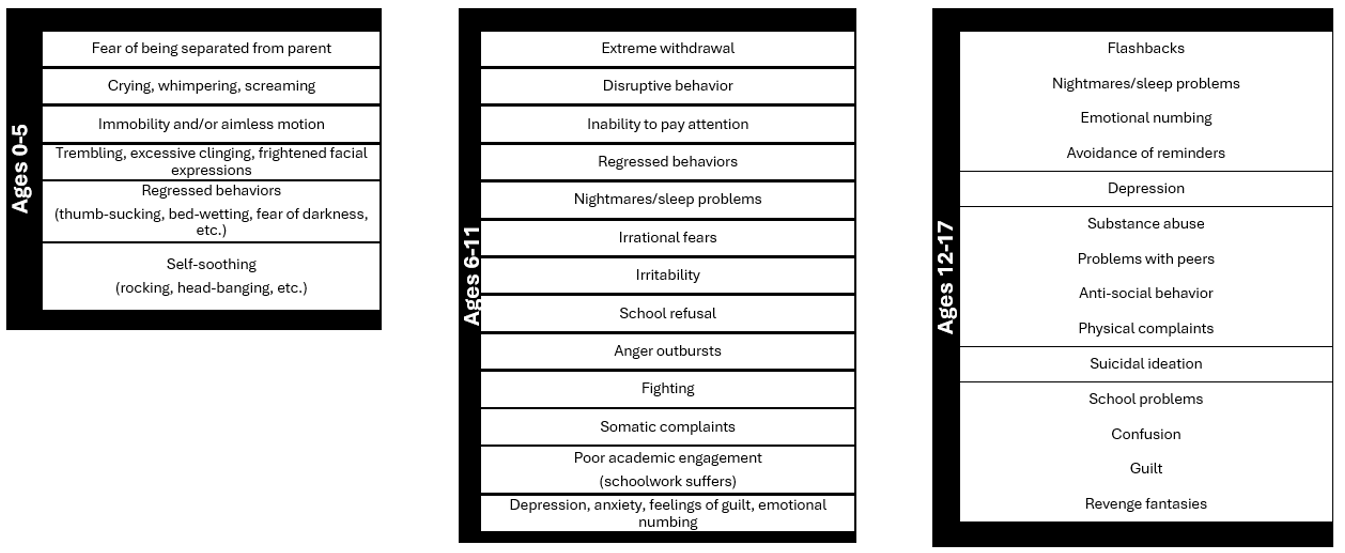
Trauma manifests differently across developmental stages, reflecting variations in cognitive, emotional and social capacity.
Early childhood (0–5 years): heightened separation distress, regression, sleep disturbance and self-soothing behaviours.
Middle childhood (6–11 years): emotional dysregulation, learning difficulties, behavioural challenges and somatic complaints.
Adolescence (12–17 years): depression, substance use, risk-taking behaviour, dissociation and identity difficulties.
These responses are best understood as adaptive survival strategies, rather than wilful misconduct (van der Kolk, 2014; Forkey et al., 2021).
A more comprehensive list can include the following:
Trauma, Memory and the Body
Trauma is frequently encoded in implicit memory systems, particularly when experienced in early childhood. As a result, traumatic stress may be expressed somatically or behaviourally rather than verbally (van der Kolk, 2014). In terms of the somatic, it can be that physical symptoms are experienced even when there is no obvious injury or medical cause. It can be easy to overlook that in practice without acknowledging the link to psychological trauma. Perhaps it might make us reexamine our own reaction towards the young person in our care who keeps complaining of pain despite there being nothing medically wrong.
Emerging evidence also highlights the intergenerational transmission of trauma, mediated through biological stress pathways and relational patterns (Shonkoff et al., 2012). This underscores the need for approaches that address both body-based and relational aspects of trauma recovery. Most commonly, intergenerational transmission is understood through learned behaviours, attachment patterns and relational dynamics within families. However, there is also a growing body of epigenetic research exploring how trauma may impact stress-response systems and potentially create biological changes that affect how future generations respond to stress.
Sensory Processing and Trauma
There is growing recognition that trauma significantly impacts sensory processing, with children demonstrating patterns of hyper-responsivity, hypo-responsivity or sensory-seeking behaviour (Matson et al., 2023). Recent studies indicate strong correlations between sensory modulation difficulties and emotional distress in trauma-exposed children (Liberman et al., 2026).
Sensory dysregulation may increase vigilance, impair concentration and exacerbate behavioural responses, particularly in environments that are unpredictable or overstimulating. Supporting sensory regulation is therefore a critical component of trauma-informed intervention (Matson et al., 2023). As practitioners, we also need to be actively engaging with the educational providers of our children and young people to ensure that such factors are given due consideration within the classroom environment.
Trauma-Informed and Relational Practice
Trauma-informed practice represents a paradigm shift from asking “What is wrong with this child?” to “What has happened to this child?” (Forkey et al., 2021). Core principles include safety, trustworthiness, collaboration, empowerment and cultural humility.
Relational approaches emphasise the healing potential of consistent, attuned relationship, recognising that many traumatised children fear closeness because relationships may have previously been unsafe (Cook et al., 2005). This is where it requires practitioners to go the extra mile, to ensure that we are the people in their life who do not give up on them.
The PACE framework – Playfulness, Acceptance, Curiosity and Empathy – developed by Hughes (2017), operationalises trauma-informed relational care by supporting emotional containment and connection, particularly during moments of dysregulation. This framework remains intrinsic to our work in residential settings.
Practitioner Wellbeing and Reflective Systems
It is also important for all of us – especially those in a supervisory capacity – to understand that working with trauma-exposed children carries a risk of vicarious trauma and emotional exhaustion. Trauma-informed systems must therefore extend care to practitioners through reflective supervision, organisational safety and cultures that tolerate uncertainty and emotional complexity (Marsac et al., 2019). There can be no room for toxicity within the management culture of the settings in which we are providing our services.
Sustainable trauma-informed practice requires addressing both individual and systemic factors, recognising that practitioner wellbeing directly influences relational capacity. If we are not all collectively looked after, then how are we meant to provide the best level of support to the children and young people who need it most?
Conclusion
Complex trauma exerts profound effects on children’s development, relationships and sense of self. However, recovery and healing are possible when systems and practitioners respond with understanding, compassion and relational safety. It is important that we celebrate our examples of this for inspiration.
Trauma-informed, developmentally attuned practice reframes behaviour as communication and positions relationships as the primary vehicle for healing. For children whose early experiences taught them that the world is unsafe (such as the young man we met at the start of this article), consistent and empathetic care can restore trust, agency and hope.
References
Cook, A., Blaustein, M., Spinazzola, J. and van der Kolk, B. (2005) Complex Trauma in Children and Adolescents. Los Angeles, CA: National Child Traumatic Stress Network.
de Magalhães‑Barbosa, M.C., Prata‑Barbosa, A. and Cunha, A.J.L.A. (2021) ‘Toxic stress, epigenetics and child development’, Journal of Pediatrics, 98(S1), pp. S13–S18.
Forkey, H., Szilagyi, M., Kelly, E. and Duffee, J. (2021) ‘Trauma‑informed care’, Pediatrics, 148(2).
Hughes, D. (2017) Building the Bonds of Attachment. 3rd ed. Lanham, MD: Rowman & Littlefield.
Liberman, L., Harel, E. and Gilboa, Y. (2026) ‘Sensory processing disorders and emotional distress among young children exposed to traumatic events’, American Journal of Occupational Therapy, 80(3).
Marsac, M.L., Cutuli, J.J. and Alderfer, M.A. (2019) ‘Trauma‑informed care for children and families’, Psychological Services, 16(1), pp. 1–3.
Matson, R., Barnes‑Brown, V. and Stonall, R. (2023) ‘The impact of childhood trauma on sensory processing and motor skills: A scoping review’, Journal of Child & Adolescent Trauma, 17(2), pp. 447–456.
Shonkoff, J.P. et al. (2012) ‘The lifelong effects of early childhood adversity and toxic stress’, Pediatrics, 129(1), pp. e232–e246.
van der Kolk, B. (2014) The Body Keeps the Score. New York: Viking.


