































Child and Youth Care (CYC) has long recognized practicum as essential to professional preparation (Cragg, 2020; Keough, 2016; Forkan & McElwee, 2002), yet we have devoted comparatively little attention to understanding how practicum contributes to students’ development as CYC practitioners. Although practicum is widely understood as an important site of learning and a bridge between theory and practice, less attention has been given to examining the educational processes that make this learning possible.
Although the terms field education, placement, and practicum are often used interchangeably, this article adopts the Child and Youth Care Educational Accreditation Board of Canada's (CYCEAB) use of practicum as the overarching term. This choice reflects an understanding of practicum as more than the completion of required practice hours; rather, it is a relational educational experience that integrates practice, supervision, critical reflection, and assessment.
This paper builds on my doctoral research exploring students’ experiences of practicum, in which participants consistently described their learning as a process of becoming rather than simply acquiring skills (McGrath, 2025). Insights from this inquiry, together with ongoing conversations with other Child and Youth Care educators, prompted a broader conceptual question that guides this paper: If practicum is central to Child and Youth Care education, what makes it educational?
Reframing Practicum as Pedagogy
Programs devote substantial resources to practicum, including coordination, faculty supervision, community partnerships, administrative infrastructure, and ongoing quality improvement. Community partners contribute expertise and create opportunities for authentic practice despite competing organizational demands, while faculty dedicate significant time and effort to supporting student learning. Students, in turn, spend hundreds of hours immersed in practice. Few components of professional education require a comparable investment of relational, organizational, and educational resources.
This commitment is reflected in the CYCEAB standards (2025), which identify practicum as a principal component of CYC education and emphasize the importance of direct relational practice, theory-practice integration, structured supervision, critical reflection, and competency development. Implicit within these standards is a recognition that practicum is defined not simply by participation in practice settings, but by the educational experiences and supports that enable professional learning.
Despite this significant role within CYC education, discipline-specific scholarship has more often examined individual elements of practicum than the processes through which it becomes educational. Existing literature has contributed important insights into supervision (Lam, 2019; McElwee et al., 2002), student experiences (Pope et al., 2025; Newberry, 2007; Beneteau, 1993), and field education structures (Pope et al., 2023; Keough, 2016; Snell, 2016; Ainsworth, 2016), while emerging work has begun to consider the pedagogical dimensions of practicum (McCallion et al., 2026; Cragg, 2020; Cragg, 2023). Further attention is needed to understand how practicum functions as an intentional educational experience through which students interpret practice, construct professional meaning, and develop as CYC practitioners.
This gap invites a different conceptualization of practicum. I propose that practicum should be understood as an intentional pedagogy through which students interpret experience, construct professional meaning, and develop the knowledge, judgement, and identity required for Child and Youth Care practice (Mann-Feder, 2021; Budd, 2020; Garfat, 2008; Garfat et al, 2018). Figure 1 (over the page) introduces the conceptual framework that informs this argument. Rather than positioning placement completion and accumulated hours as the primary educational mechanisms, the framework conceptualizes practicum as a pedagogical process in which experience provides the context for learning and intentional educational processes transform experience into meaningful professional learning.
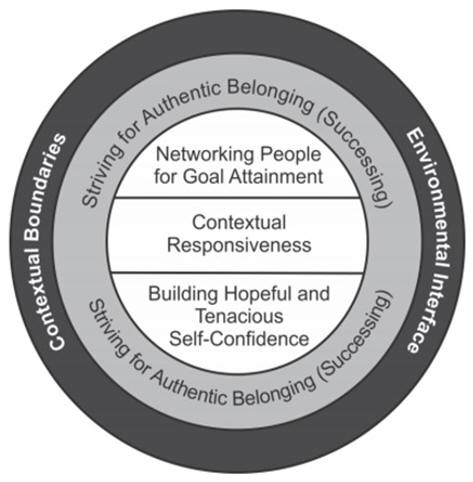
From this perspective, placement provides opportunities for experience, but pedagogy transforms experience into education. Through supervision, dialogue, critical reflection, theory integration, and guided participation, practicum educators support students in interpreting experience, constructing professional meaning, and developing the ways of thinking, relating, and practising that characterize Child and Youth Care.
Understanding practicum in this way requires moving beyond the assumption that experience alone produces learning. Educational theory has consistently demonstrated that experience does not automatically result in understanding or professional growth; rather, learning depends on how experience is interpreted, reflected upon, connected to prior knowledge, and integrated into an evolving understanding of practice. The following section draws on educational theory to examine how experience becomes learning and why practicum is best understood not simply as a placement, but as a distinct pedagogy.
The Pedagogical Processes of Practicum
Understanding practicum as pedagogy requires looking beyond experience itself to the educational processes that transform experience into learning. Experiential, reflective, transformative, and situated learning theories provide a foundation for understanding how learners interpret experience, construct knowledge, and develop professional identity.
Experience as the Foundation of Learning
Experience provides the foundation for learning, but it is not inherently educational. Dewey (1938) argued that the educational value of experience depends upon how individuals engage with, interpret, and build meaning from it. Simply participating in practice does not guarantee understanding or growth because experiences may reinforce existing assumptions, remain disconnected from future learning, or fail to contribute to professional development. Dewey therefore shifts attention away from experience itself and toward the processes that enable experience to become educational.
Building on Dewey’s work, Kolb (1984) explains how experience becomes learning through an ongoing cycle of reflection, conceptualization, and experimentation. Experience initiates learning, but reflection enables learners to examine what occurred, connect it to broader ideas, and apply new understandings to future situations. Learning is therefore not a single event but a continuous process in which each experience informs the next.
Reflection as Knowledge Construction in Practice
Reflective learning theories illuminate how practitioners develop knowledge through engagement with complex situations. Schön (1983; 1987) argues that professional practice involves more than applying previously acquired knowledge. Practitioners construct knowledge while navigating uncertainty, ambiguity, and complexity. Reflection occurs both during and after experiences as practitioners notice unexpected events, reconsider assumptions, and adapt their responses.
Mezirow (1991) extends this understanding by emphasizing the transformative potential of reflection. Learning becomes transformative when individuals critically examine the assumptions and perspectives through which they interpret their experiences. Through this process, learners develop new ways of understanding themselves, others, and their work. Learning is therefore not simply the acquisition of knowledge but the reconstruction of meaning.
Participation and Professional Becoming
Finally, Wenger (1991) and Wenger et al (2002) situates learning within communities of practice. Professional knowledge develops through relationships, shared practice, and increasing participation within a professional community. As learners participate alongside others, they develop not only new understandings but also a growing sense of professional identity. Learning is therefore both cognitive and relational, representing a process of becoming as much as a process of knowing.
From Learning Theory to Practicum
Considered together, these perspectives describe professional learning as an iterative rather than linear process. Dewey (1938) reminds us that experience alone is insufficient. Kolb (1984) explains how reflection transforms experience into learning. Schön (1983; 1987) demonstrates that this reflective process continues within the uncertainty of professional practice. Mezirow (1991) shows how reflection becomes transformative through meaning-making, while Wenger et al (2001) illustrates how participation and relationships contribute to the ongoing development of professional identity. Rather than offering competing explanations, these theorists collectively describe complementary dimensions of how professionals learn and continue to develop throughout their careers.
From this perspective, practicum can be understood as the beginning of an ongoing cycle of professional learning rather than a discrete educational event. Experience generates opportunities for reflection; reflection shapes interpretation; interpretation contributes to meaning-making; meaning-making influences professional identity; and that evolving identity, in turn, shapes how practitioners engage with subsequent experiences. Each new encounter is understood differently because it is interpreted by someone whose knowledge, judgement, relationships, and sense of professional self have been reshaped by previous experiences. Learning is continuous, with each experience shaping how students think, relate to others, and engage in practice.
This understanding highlights the importance of intentional educational scaffolding within practicum. Learners require opportunities to revisit experiences, integrate knowledge with self and practice, and examine their developing understandings through dialogue and critical inquiry. Within practicum, seminar provides an essential pedagogical space where students explore practice experiences with peers and faculty, making meaning of their work in relation to broader professional knowledge (McCallion et al., 2026). Practicum, therefore, is not simply a period of accumulating experience but an intentional educational process that supports the development of professional judgement, identity, and praxis (White, 2008).
This understanding of practicum also aligns with principles of adult learning. Knowles et al. (2015) argued that adult learners bring prior experiences, established beliefs, and emerging aspirations to educational settings, and that meaningful learning occurs when those experiences become resources for inquiry rather than simply background to new knowledge. Adult learners are motivated by opportunities to solve authentic problems, assume increasing responsibility for their own learning, and connect new ideas with lived experience. Practicum creates these conditions by engaging students in authentic professional contexts while providing intentional opportunities to interpret experience, develop autonomy, and exercise professional judgement. In this sense, practicum is more than experiential learning; it is an adult learning environment in which students actively construct professional meaning, negotiate identity, and assume growing responsibility for their ongoing development as Child and Youth Care practitioners. If practicum depends upon educational processes rather than experience alone, who intentionally supports students in this learning?
The Pedagogical Role of the Practicum Educator
Understanding practicum as pedagogy fundamentally reframes the role of the practicum educator. Unlike many classroom-based courses, practicum educators teach within uncertainty. Students learn across diverse agencies, supervisory relationships, organizational cultures, and practice contexts, each offering different opportunities and challenges. No two students encounter the same learning experiences, despite working toward common educational outcomes. The educator cannot control these learning environments, but they can create and guide the conditions through which students learn from them.
This work extends well beyond coordinating placements or evaluating performance. Practicum educators help students integrate knowledge, navigate ambiguity and personal responses, and develop professional judgement within practice situations that are often unpredictable and highly individualized. Through reflection, dialogue, and inquiry, they help students move from experiencing practice to learning through practice. They invite students to notice what is occurring within relationships and practice contexts; interpret events through Child and Youth Care theory and values; articulate the reasoning that informs their decisions; connect classroom learning with lived experience; and critically examine assumptions, biases, and responses. In doing so, they support students in making meaning of practice in ways that deepen their understanding of Child and Youth Care and contribute to the development of their professional identity. For example, a student may initially describe a difficult interaction with a young person as “non-compliance.” Through questioning and reflection, the educator helps the student consider the relational, developmental, and contextual influences shaping the interaction, connecting the experience to broader understandings of Child and Youth Care practice.
Community partners provide significant contributions to practicum education by providing authentic learning environments and on-site supervision. Yet community organizations are not educational institutions, nor should they be expected to assume sole responsibility for teaching the Child and Youth Care profession. Their primary commitment is to the children, youth, families, and communities they serve. Student supervision is one of many competing responsibilities, and field supervisors bring diverse professional backgrounds and understandings of Child and Youth Care practice. These variations contribute to the complexity of practicum and reinforce the need for intentional educational processes that help students interpret and integrate their experiences (Cragg, 2020).
These differences should not be understood as deficits. Rather, they reinforce the importance of the practicum educator, who helps students make sense of experience through the distinctive values and principles of Child and Youth Care (Digney, 2024; Garfat et al, 2018) while supporting community partners in understanding the profession's unique contribution. From this perspective, professional formation is possible in diverse practice settings because learning depends less on the setting itself than on how students critically engage with relationships, context, ethics, and intervention. Interdisciplinary environments can be especially valuable, challenging students to clarify and articulate what makes Child and Youth Care practice distinctive. For example, explaining the rationale for a relational intervention to a colleague or supervisor may require students to clarify their own assumptions about Child and Youth Care, strengthening both their professional understanding and confidence.
The practicum educator's expertise lies not in controlling the learning environment or delivering a common body of content, but in transforming diverse experiences into meaningful professional learning. Their pedagogical work provides the continuity that enables students to construct professional meaning across varied contexts and, ultimately, to develop as Child and Youth Care practitioners.
What Changes When Practicum is Understood as Pedagogy?
Viewing practicum through a pedagogical lens shifts how it is understood within Child and Youth Care education. Four interconnected conceptual shifts emerge from the argument developed in this paper.
From Placement to Curriculum
Practicum should be understood as a deliberately designed curriculum with intended learning outcomes, pedagogical processes, opportunities for inquiry, and mechanisms for assessment. The placement in a community setting provides the context for learning, but the curriculum provides educational coherence and purpose.
Experience alone does not produce learning. Through questioning, dialogue, feedback, critical reflection, and guided inquiry, practicum educators help students interpret their experiences, connect different forms of knowledge with practice, and construct professional meaning.
From Competency to Professional Formation
Competencies remain important, but practicum is ultimately about who students are becoming as practitioners. Professional formation encompasses use of self, identity, judgement, relational capacity, ethical discernment, and commitment to the values of Child and Youth Care.
From Coordination to Pedagogical Leadership
The practicum educator designs learning, supports reflection, encourages integration, works collaboratively with community partners, and guides students through complex developmental processes. Their influence shapes not only what students learn, but how they learn and who they become.
Implications of Practicum as Pedagogy
Reframing practicum as pedagogy rather than placement invites new questions about professional education. If practicum is understood as an integrative educational process, then its design, delivery, and evaluation require reconsideration. This includes how programs prepare and support practicum educators, integrate curriculum with field learning, sustain relationships with community partners, and assess student development. Evaluation must extend beyond observable competencies to consider the development of professional judgement, ethical reasoning, relational understanding, reflective capacity, and professional identity. This paper does not attempt to resolve these questions; rather, it suggests that these are the questions that emerge when practicum is understood as a distinctive pedagogical endeavour.
Conclusion
This paper has argued that recognizing practicum as pedagogy changes how we think about student learning in practice. Through practicum, students learn to interpret experience, develop professional judgement, and cultivate a growing sense of themselves as Child and Youth Care practitioners. The educational value of practicum lies not only in the placement setting, but in the intentional educational processes that help students connect experience, reflection, theory, self, and practice. Reframing practicum as pedagogy shifts attention from managing field experiences to creating the conditions through which professional knowledge, identity, and ways of being are refined. In doing so, it provides a framework for understanding how students come to embody and confidently enact what it means to practise in ways that are distinctly and recognizably Child and Youth Care.
References
See PDF for full reference list.


