



































The complete set of 198 Hints are available in paperback from the CYC-Net Press store.

 Listen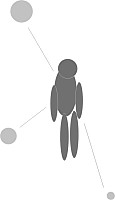
Young people who come into Child and Youth Care programs usually have very limited social networks. If we take the time to "map" the significant people they have in their lives (and consider a few variables such as positive-negative, nearby-far, etc.) we will often come up with a map such as the tragically limited one on the left – both a consequence of past difficulties and a constraint on future healthy development.
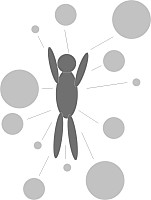
Comparing this with a healthy functioning youngster in the same neighbourhood, we may see a map like the one on the right – which includes parents, siblings, neighbours, school friends, sports teams, boyfriends and girlfriends, local shops, church, interest groups ...a variety of younger and older, family, school and community people who sustain the child in a bouyant trampoline-like network.
The map on the left is also very precarious, in that one or more of these relationships may be conflicted or negative, and the youth can become overly reliant or neurotically enmeshed with whoever remains. When youngsters become "stuck" at a relationship which is not coming right, particularly with a parent, they use up time and energy on this preoccupying relationship, and are not free to move out to explore new relationships.
Which brings us to our task as child and youth workers.
In theory, the map on the left can become richer and more helpful (a) when the youngster is freed from the things which immobilise and (b) when increased inter-personal encounters are facilitated.
In practice, it often takes just one person to "enter" the empty map ... one person who wants to take an interest and who welcomes, includes, invites, connects ... This one person is probably you. The Child and Youth Care relationship begins by offering an additional choice We represent the possibility of other meaningful relationships, and hopefully we get to prove wrong a child's negative expectations about other people. We begin to loosen the logjam. When one extra person has the will and the skill to join the map, those "things which immobilise" start to shrink in significance. Our relationship can be the prototype for – and then the bridge towards – future helpful relationships and social networks.
Draw the map. It sketches a useful picture of young people's social contexts, suggests what needs to be added to the mixture, and offers a simple graphical measure of their improving personal and social functioning.
Make sure you are in the map.


