



































The complete set of 198 Hints are available in paperback from the CYC-Net Press store.
 Listen
 Learning continua ... not on-off switches
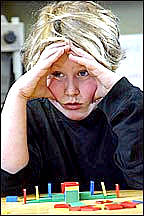
In Practice Hint 193 (Black-and-white) we talked about using words like "thief" to describe a child or youth – as though they were a thief, all thief and nothing but a thief. To say "Margaret is a thief" doesn’t leave much else to be said. We saw how somebody could believe simplistically that a child is a thief or is not a thief, rather as if there is a switch which can be turned either one way or the other.
Nothing in life is quite that simple.
A little child who has the run of the house finds it hard to understand how we may all use the floor to walk on and a dish to eat out of – yet suddenly something is described as Daddy’s keys or Mommy’s shoes. The child is taught that "This is your toy or your doll", yet when a similar toy or doll is discovered in a friend’s house there is the warning "This is Jane’s doll" or "This is David’s toy!" There is a complex system of codes and customs to be learned. We can observe this in a play school where little children are in turn thrilled to have their piece of paper and outraged when a similar piece of paper is definitely not theirs.
In work with difficult and troubled kids, we find that other confusions and disturbances in their lives have blurred boundaries and rules like this, and delayed their learning and acceptance of such lessons.
* * *
If we find that a child has "taken" something which belongs to another, we are careful not to rush for the label "thief". What is always better is to find a neutral and objective name for the life skill we are working at – in this case, for example, "Respect for others’ property" – and then to work out how much more we have to teach before the child gets it right. As specialists in child and youth development, this is our job: to map out the curriculum of precept, example and experience which teaches this skill.
The neutral name for the skill also allows us to plot how far the child has already progressed along this particular learning continuum. To say "thief" is to suggest that the child has learned nothing at all, and we demand that they arrive instantly at the "not thief" end of the continuum. Nobody learns like that.
When we can reflect back to a child how much they have already learned about respect for others’ property, they are encouraged, they get credit for gains already made, and can better grasp the way ahead which we are indicating.
In our practice today we will be aware of some of the "shoot-from-the-hip" words we use to describe annoying or troubling behaviour – and rather work our the neutral and objective label for the skill we are teaching. We will be surprised at how helpful it for us to move from vague descriptors ("she’s a nuisance") or negative labels (he’s a bully") and talk in terms of ability to gauge a social situation or ability to express frustration. When we understand this difficult role of Child and Youth Care workers, we see the silliness of "taking away 3 points" or moving them down to a lower level!


