



































The complete set of 198 Hints are available in paperback from the CYC-Net Press store.



 Listen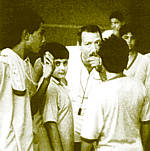
It was suggested during a meeting with teachers that girls are able to express their feelings more readily than boys, and that in a school setting it was harder for teachers to get to know the boys, especially when they might have issues and hurts on their minds.
Whether this boy-girl difference is changing is uncertain, but it has been "a boy thing" that one keeps one’s feeling to oneself. Indeed, the male group at school level often imposes some strong sanctions on the sharing of feelings. Martino (1995) suggests that "boys in their peer group might police masculinity ... through a series of put-downs at throwing into question a boy’s sexuality." Whatever, reticence in sharing feelings can prove a difficulty for child care workers, teachers and others who fear that they are not "hearing" kids in difficulty and may be dealing with these kids harmfully or unhelpfully.
One solution is to redefine the "space" in which adults meet with children. A colleague who runs a program for difficult boys sets aside an obligatory twenty minutes at the end of each day when the unit careworkers and their groups of boys meet to talk about their day. The regularity of this more intimate and "umpired" period sets it apart as a safe and sympathetic grouping, quite in contrast with the normallly "male" activities of the day. The class teacher, similarly, might establish such safe "spaces" in terms of certain topics which the class can discuss: "John has had this worrying experience ... " or "The class has this problem ... which I think we need some help with and some of you may have some ideas." Such an opening allows a teacher to say next week: "Remember we discussed that worrying issue the other day ... "
One of the important issues we are discovering about crime and violence is the lack of empathy amongst youth, and we are seeing more and more attempts to remedy this. Listening to each others’ feelings is central to these attempts. We need to create ways to facilitate this process.
Reference
Martino, W. (1995) It’s not the way guys think. In Browne,
R. and Fletcher, R. (eds.) Boys in schools: Addressing the real issues.
Sydney: Finch Publishing, pp. 129-130


