



































The complete set of 198 Hints are available in paperback from the CYC-Net Press store.
 Listen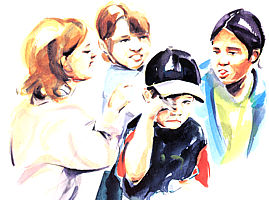
Sooner or later every Child and Youth Care worker is going to have to deal with an "incident" – in which a frightened, sad or infuriated young person is going to go over the edge. This sort of incident will see a youth behaving irrationally and dramatically, being overwhelmed by tragic unhappiness or expressing rage in an alarming outburst or destructive attack on person or property.
We all know that this is a situation which needs to be de-escalated, that is, in which harm or damage must be limited and controlled, and when the protagonists most need our targeted and skilled support. Our priority is to see that nobody is hurt and that the out-of-control youth is maximally "cushioned" – by being presented with minimal threat (whether physical or emotional) and maximum resources (whether physical or emotional). You and I know that we ourselves can lose control and make mistakes when we are most ‘down’ and vulnerable, and to recognise this condition in the ‘troubled youth’ we work with, is to target most accurately the responses we make.
There is another factor. When we are faced with a situation in the life space, it may be best to move the action away from the group to where there is least exposure/embarrassment for the young person concerned. To be seen crying or losing control can make even harder for her/him to maintain an already fragile self-image. "Let’s go and sit in here," is often the least kindness we can offer.
But also, there are times when we feel confident in our ability to be useful in these "public" circumstances, and our sympathetic and constructive intervention can be of great help to the other kids in the room. The theory of projection tells us that the kids who may tease and attack the unhappy youth who has "lost it" are themselves the most likely to have similar feelings of distress and helplessness. When we allow an "incident" to play out in front of others, we give them affirmation and hope in seeing that their pain and feelings are legitimate and can be met with understanding and support.
In our practice today we may want to shield hurt individuals from the public gaze; on the other hand, if we have the gifts and skills, we may just as well wish to share, in the life-space, an intervention that may show that there is hope and healing available for kids who are pushed to the limit.


